U.S. Sports Betting Tax Revenue

On Tuesday, February 13, Adam Grundy (supervisory statistician in the U.S. Census Bureau’s Economic Management Division) published an article entitled “Quarterly Survey of State and Local Tax Revenue Shows Which States Collected the Most Revenue from Legalized Sports Betting.”
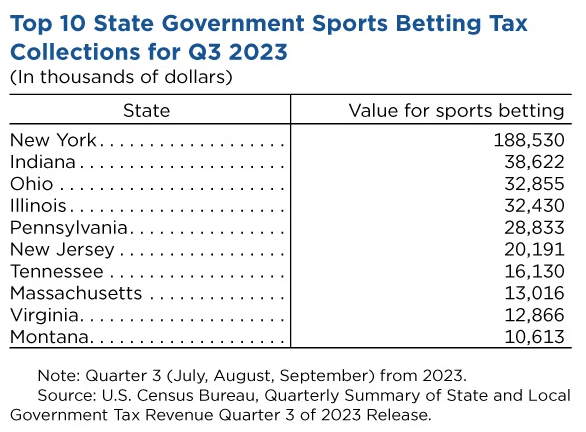
According to Grundy:

New York was the state with the largest share of the nation’s tax revenue in the (third) quarter of 2023: $188.53 million or more than 37% of total tax revenue and gross receipts from sports betting in the United States. Indiana ($38.6 million) and Ohio ($32.9 million) followed.

From https://www.census.gov/library/stories/2024/02/legal-sports-betting.html.

Are you wondering why populous states such as California and Texas don’t appear on the list? That’s because sports betting is only legal in 38 states and the District of Columbia.

Sports betting in any form is currently illegal in California, Texas, Idaho, Utah, Minnesota, Missouri, Alabama, Georgia, South Carolina, Oklahoma, Alaska and Hawaii.

From https://www.forbes.com/betting/legal/states-where-sports-betting-is-legal/#states_where_sports_betting_is_illegal_section.

Sports betting was not legal in Florida during the 3rd quarter of 2023, but was subsequently legalized.

Which returns us to California and Texas, opposites in many ways, who are agreed in the opinion that sports betting is undesirable.

But the remaining states that allow sports betting need to ensure that the gamblers meet age verification requirements. (Even though they have a powerful incentive to let underage people gamble so that they receive more tax revenue.)

“Looks like the over-under for the NBA All-Star Game is 400, Mikey.” By Adrian Pingstone – Transferred from en.wikipedia, Public Domain, https://commons.wikimedia.org/w/index.php?curid=112727

If your identity/biometric firm offers an age verification solution, and you need content to publicize your solution, contact Bredemarket.

How Unusual Gambling Portals Drive the Need for Age Verification and Estimation

Gambling is becoming acceptable in more and more places.

When I was young, and even when I got older, the idea of locating a pro sports team in Las Vegas, Nevada was unthinkable. In the last few years, that has changed dramatically.

The Roblox “Robux” gambing lawsuit

Well, now that gambling for adults has become more and more acceptable (although adults in my home state of California still can’t gamble by phone), now attention is focusing on child gambling.

Designed by Freepik.

And no, the kids aren’t gambling U.S. currency, according to TechCrunch.

In a new class action lawsuit filed in the Northern District of California this week, two parents accuse Roblox of illegally facilitating child gambling.

While gambling is not allowed on the platform, which hosts millions of virtual games that cater to children and teens, the lawsuit points to third-party gambling sites that invite users to play blackjack, slots, roulette and other games of chance using Roblox’s in-game currency.

From https://techcrunch.com/2023/08/18/roblox-children-gambling-class-action-lawsuit-robux/?_hsmi=271025889

But the gambling sites’ terms of service prohibit underage gambling!

I’m not going to concentrate on Roblox here, but on the other defendants—the ones who actually operate the sites that allegedly allow child gambling.

The lawsuit specifically names RBXFlip, Bloxflip and RBLXWild as participants in “an illegal gambling operation that is preying on children nationwide.” 

From https://techcrunch.com/2023/08/18/roblox-children-gambling-class-action-lawsuit-robux/?_hsmi=271025889

But according to Bloxflip’s Terms of Service, it’s impossible that children can be using the site, because the Terms of Service prohibit this.

By accessing Bloxflip or using the Services, you accept and agree to our website policies, including these Terms of Service, and you certify to us that (i) you are eighteen (18) years of age or older, and are at least the age of majority in your jurisdiction, (ii) you are not a resident of Washington, (iii) you have the legal capacity to enter into and agree to these Terms of Service, (iv) you are using the Services freely, voluntarily, willingly, and for your own personal enjoyment, and (v) you will only provide accurate and complete information to us and promptly update this information as necessary to maintain its accuracy and completeness.

From https://bloxflip.com/terms

However, stating a minimum age in your TOS is even less effective than other common age verification methods, such as

  1. Asking your customer to check a box to say that they are over 18 years old.
  2. Asking your customer to type in their birthday.
  3. Requiring your customer to read a detailed description of IRA/401(k) funding strategies and the medical need for colonoscopies. (This would be more effective than the first two methods.)

A better way to verify and estimate ages

As more and more companies are realizing, however, there are other ways to measure customer ages, including a comparison of a live face with a government-issued identification card (driver’s license or passport), or the use of “age estimation” software to ensure that a 12 year old isn’t gambling. (And don’t forget that NIST will test age estimation software as part of its FATE testing.)

Even when the kids aren’t gambling legal currency.