
Yes, the “Two Presidents” Scenario Could Really Happen

My recent post about two “Presidents” with the power to launch nuclear attacks sounds technologically very difficult, but it’s not impossible. Even biometric modification can happen if an adversary has enough money.

Grok.

But as is true with anything, the technology is easy. The business part is the difficult part.

And most would argue that there is absolutely no way that a scam like this could be pulled off, especially since it would require inside cooperation.

Perhaps you’d better sit down.

August 9, 1974

Washington, DC was in a very confused state on August 9, 1974. When the day began, Richard Nixon was President and Gerald Ford was Vice President. Several hours later Ford would be President and there was no Vice President. (If Ford had suddenly died, Speaker of the House Carl Albert would have become President. If you thought the events of 1973 and 1974 were wild enough, imagine if Albert had become President.)

The morning of August 9 was carefully choreographed, but I am going to concentrate on two events involving Richard Nixon, Alexander Haig, and Henry Kissinger.

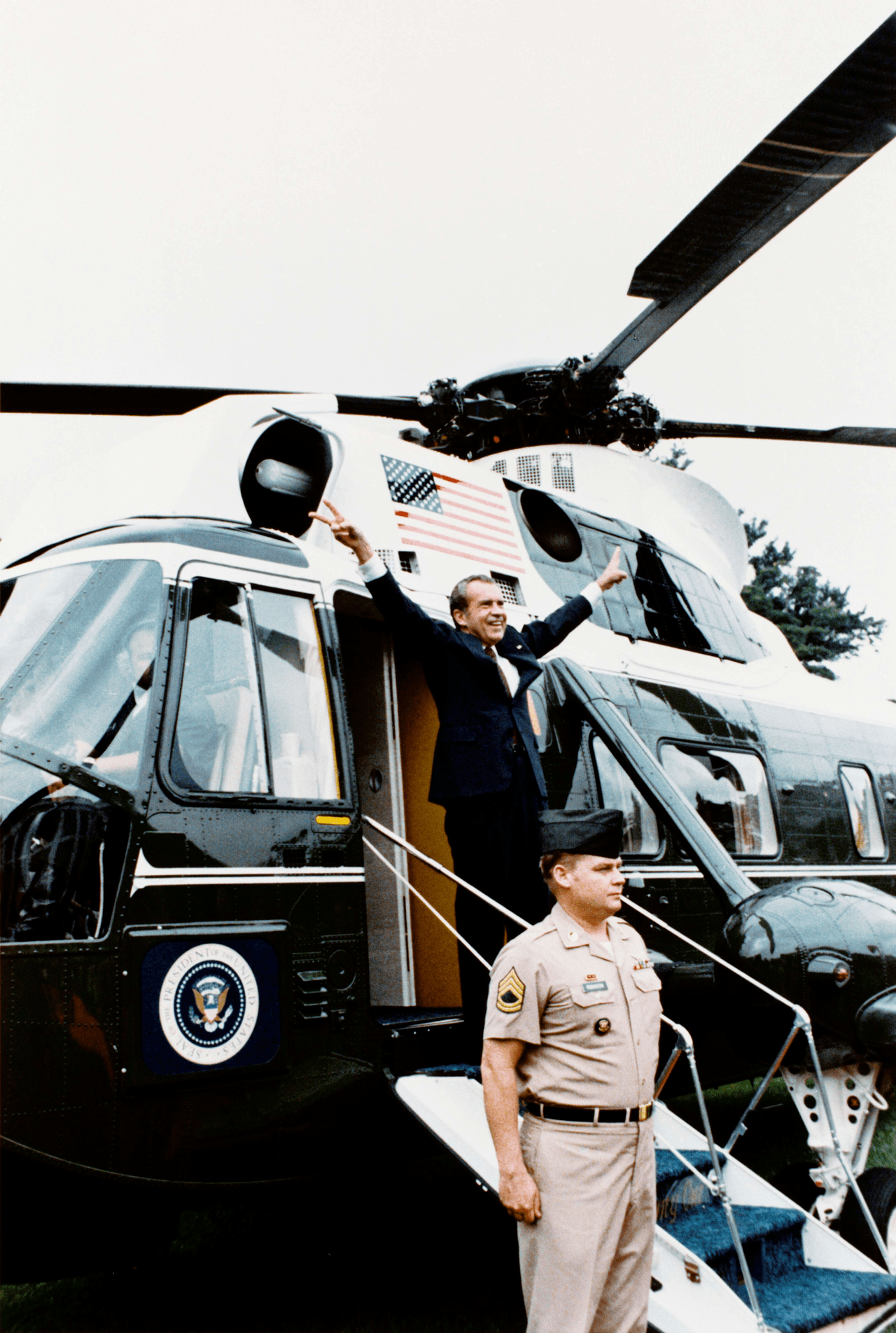
  • The first occurred at about 10:35 am when President Richard Nixon’s helicopter lifted off from the South Lawn, headed toward what was then Andrews Air Force Base.
  • The second occurred later, at about 11:35, when White House Chief of Staff walked into the office of Henry Kissinger, in Kissinger’s capacity as Secretary of State. Haig’s arrival was expected, as was the signed letter that he bore from President Nixon (en route to California). The letter was short.

“I hereby resign the Office of President of the United States.”

Kissinger indicated his receipt of the resignation and maintained communications with critical people, including Vice President Gerald Ford.

But there was one other critical person: the Secretary of Defense, James Schlesinger.

And there was one very important part of the choreography that wasn’t mentioned publicly that day.

Back to the Helicopter

I don’t know if “biscuits” existed in 1974, but footballs certainly did. And certainly the concept of continuity hadn’t yet matured to the Carter-Mondale level. But everyone agreed that according to the Constitution, on that day Richard Nixon remained President of the United States until he didn’t.

But according to reality, Nixon was…stressed.

“Schlesinger feared that the president, who seemed depressed and was drinking heavily, might order Armageddon. Nixon himself had stoked official fears during a meeting with congressmen during which he reportedly said, “I can go in my office and pick up a telephone, and in 25 minutes, millions of people will be dead.” Senator Alan Cranston had phoned Schlesinger, warning about “the need for keeping a berserk president from plunging us into a holocaust.””

And Schlesinger acted. When a liberal Democratic Senator demands action from a conservative Administration, sometimes things happen.

While some of the 1974 actions of Schlesinger, Kissinger, and Haig during the “final days” are murky, there is general agreement that Schlesinger gave a rather unusual order to the military.

“[I]n the final days of the Nixon presidency he had issued an unprecedented set of orders: If the president gave any nuclear launch order, military commanders should check with either him or Secretary of State Henry Kissinger before executing them.”

This is entirely against the Constitution. If the Vice President and Cabinet doubted the sanity of the President, the proper avenue was a 25th Amendment removal—not an inferior official disobeying the instructions of the Commander-in-Chief.

However, in those strange days, in which many things happened in secret, one can understand why Schlesinger did what he did.

But there was one other critical decision that was made on August 9.

Remember when President Nixon boarded the helicopter?

“[T]he most critical tool of the modern presidency had already been taken away from him. He never noticed it, but the nuclear “football” didn’t travel with him as he boarded the helicopter, and later, Air Force One for his flight back to California.”

Yes, the football. The thing that was ALWAYS with the President because the USSR could launch a nuclear attack at any moment.

Remember that Nixon was still President an hour after boarding the helicopter, when Kissinger received a visit from Haig. But if the U.S. had been attacked during that hour, the President couldn’t respond.

And the Vice President didn’t have the power to respond.

The football appears to have been in the custody of military aides outside the East Room, awaiting the moment that Gerald Ford would take the oath of office. (Although he was already President once Kissinger indicated his receipt of the resignation letter.)

But…who controlled the football?

Schlesinger?

Kissinger?

Carl Albert?

In the end nothing bad happened, but it could have.

And it’s therefore entirely possible that the aforementioned “two Presidents” scenario could happen.

Vous n’êtes pas du coin, n’est-ce pas ?

In a recent conversation with a client, I was reminded that procedures in one country may not be followed in another. For example, the process of getting a U.S. passport differs from the process to get one in France.

By Nikimura – Own work, CC BY-SA 4.0, https://commons.wikimedia.org/w/index.php?curid=147981790

The client’s questions about ID document issuance

The client asked me about my experience with centralized and decentralized ID document issuance systems.

It turns out I was experienced in both based upon my time at IDEMIA. State agencies can manufacture driver’s licenses either via a dencentralized process where the driver’s license is printed at your local DMV office while you wait, or via a centralized process where all the driver’s licenses are produced at a secure facility which may or may not be located in the state in question. IDEMIA maintains several such centralized facilities to produce driver’s licenses and credit card-related materials, and they’re so secure that even when I was an IDEMIA employee I was not allowed to enter them.

Exton, Pennsylvania IDEMIA facility. “The property is ‘mission critical’ to IDEMIA, as it serves as the only manufacturing plant of card blanks for IDEMIA within the United States.” From https://royaloakrealtytrust.com/properties/idemia-identity-security/.

But then the client asked about passports.

Passports and passport renewals in the United States

When I joined Incode Technologies in May 2022, I had to quickly renew my passport so that I could attend a possible meeting in Mexico City. And it’s a good thing I did, because that meeting occurred soon afterwards…well, if you consider April 2023 “soon afterwards.”

My passport had expired in 2020, but I was able to renew my passport anyway with a fairly simple procedure.

  • Go to my local CVS drug store and use their automated machine to take the required passport photo in an ICAO-compliant fashion. The machine checked for ICAO compliance. (It took a few tries to get it right.)
  • Fill out a paper form.
  • Use an antiquated currency technology called a “check” to make out a payment to the U.S. State Department.
  • Put everything in an envelope and mail it to a centralized passport processing center.
  • Wait.
No, passports are not produced at the U.S. State Department headquarters. But the building looks cool. Source: diplomacy.state.gov, Public Domain, https://commons.wikimedia.org/w/index.php?curid=51192214

I forget how many weeks it took me to get my new passport, but I requested an expedited process so it couldn’t have been that many weeks.

This isn’t always true. If you don’t expedite the process, and if there’s a heavy backlog, it could take more than a month to get your passport.

Passports and passport renewals in France

After my meeting with the client, I was curious about the passport policies in other countries, and ran across this Expatica description of French passport production.

Let’s skip right to the biggest difference between France and the United States:

The passport will take a few days to process.

Uh…what?

Not “the passport will take a few days to process if you pay rush fees.”

It will take a few days to process, period.

And no, this isn’t because the United States is larger than France. The same time period applies if you apply for a passport in one of France’s scattered overseas departments, or at a French embassy or consulate.

So how do they do it?

First off, you don’t need to mail a bunch of stuff off to a centralized office. You can simply go to your local town hall (mairie), embassy, or consulate. You need the following:

  • A French ID card or other acceptable proof of French nationality.
  • A recent photograph (again, ICAO compliant).
  • Your fingers, which are presumably attached to your person, so that they can be captured for biometric purposes.
  • Proof of residence.
  • The passport fee.

Once your bring everything to the mairie, your passport is processed within a few days. (OK, perhaps slightly longer in the summer.) When it’s ready you go back to the mairie, sign your passport, and take it with you to travel to all of the countries you can visit with a French passport. (More than with a United States passport.)

Follow your local, um, customs

My research hasn’t yet uncovered a country where you can get your passport on the same day you apply for it, but such a timeframe is theoretically possible.

This isn’t a current concern of mine since Bredemarket only deals with U.S. firms, but some of these firms are multinational and may ask me to create written content regarding their installation in Vietnam or wherever.

Always ask what the local practice is and don’t assume that the locals do things like we do in Southern California.

We surf to school. Even if we live inland. By Dennis Hill – https://www.flickr.com/photos/fontplaydotcom/2742209717/, CC BY 2.0, https://commons.wikimedia.org/w/index.php?curid=146279529.