
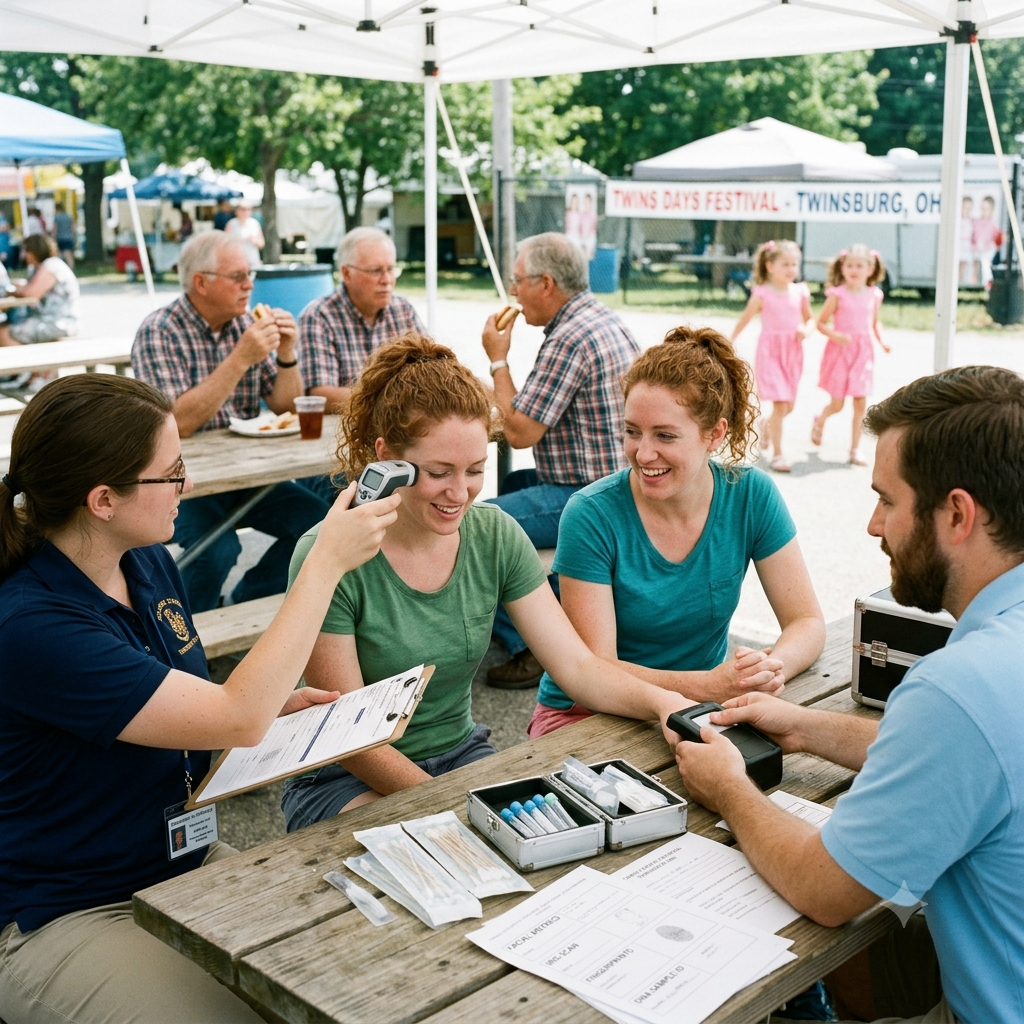
So you and your twin sibling are off to a gathering called the Twins Days Festival in Twinsburg, Ohio. There are many events in which the two of you can participate. Golf. A hot dog roast. A cornhole tournament. A “double take parade.”
And maybe, just maybe, some forensic research.
Because when you’re talking about the “something you are” identity factor (one of six), twins are more similar than non-twins. I may not be like you, but Mary-Kate is like Ashley. (And if you have to ask who Mary-Kate and Ashley are, you are obviously an immature inexperienced child from the 21st century lacking knowledge.)
But the key question: for the biometric modalities (finger, face, iris, voice, DNA, etc.), are two twins biometrically identical?
(A caveat here: Mary-Kate and Ashley Olsen are actually fraternal twins, not identical twins. But the point remains.)
For years, the Federal Bureau of Investigation and West Virginia University have gone to the Twins Days Festival to collect biometric data. Here’s an account of their 2018 visit.
“Inside the festival, a row of tents known as ‘Research Plaza’ is set up by researchers to conduct a list of surveys and tests. Hundreds of pairs of twins and multiples were surveyed last year.
“’It gives us a unique opportunity to be in an area where twins have congregated,’ explains Associate Professor Jeremy Dawson with West Virginia University. ‘There’s really nothing like it the United States.’
“Dawson works with a research team at WVU and the FBI to learn more about biometric data. ‘If two identical people are in the same database, it creates a problem for identification,’ said Dawson. ‘We hope to collect data that will help us to develop better facial recognition systems.’
“That means finding the subtle differences that make identical twins unique.”
Professor Dawson and his researchers will return to Ohio this year.

 Bredemarket