
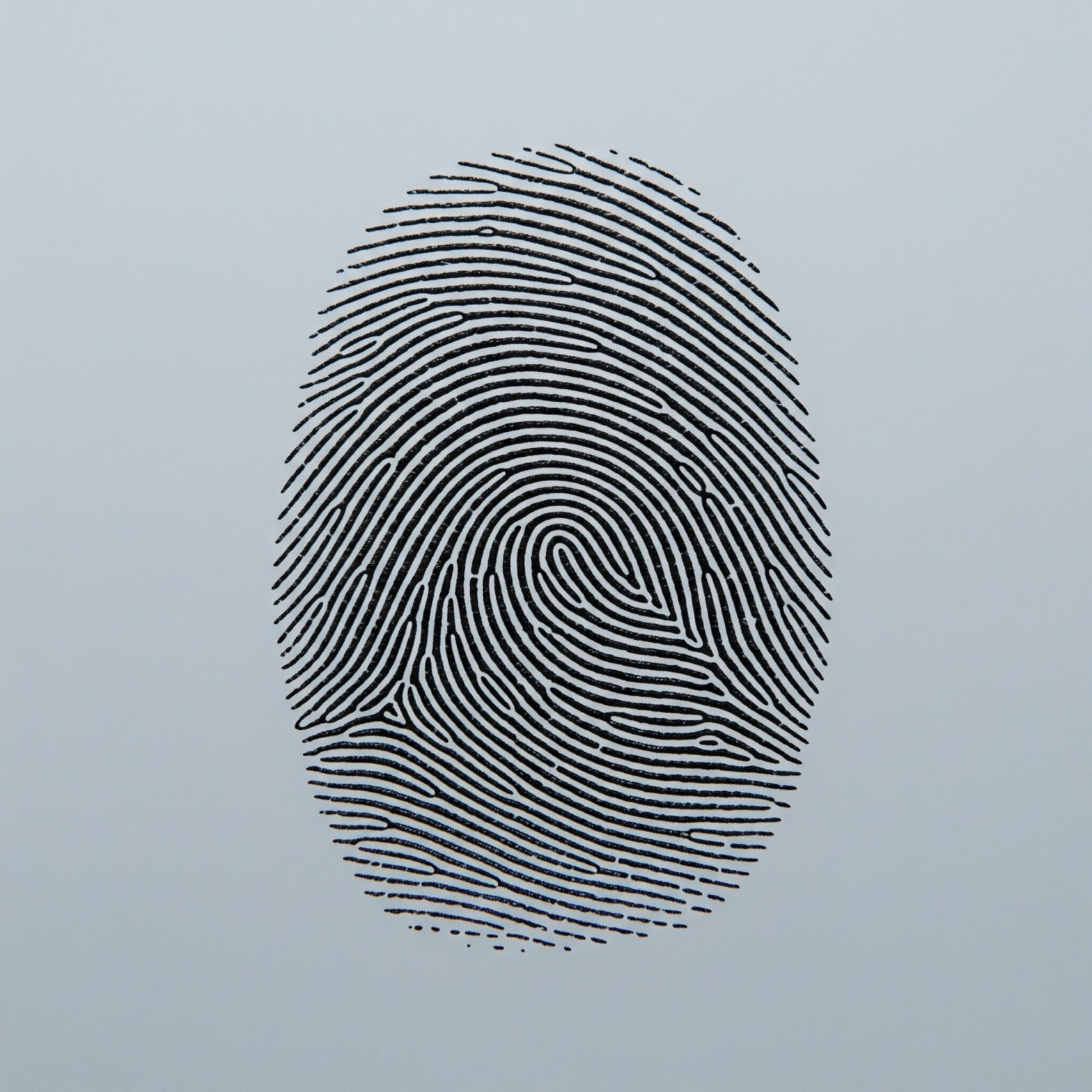
(Imagen 4)
(Part of the biometric product marketing expert series)
Because many of the subscribers and followers of my Substack page aren’t fingerprint experts (although a few are), my posts on Substack tend to be more introductory. So I wrote this for Substack, but also decided to share it on the Bredemarket blog at some point.
So let’s define what fingerprint minutiae are.
To do this, look at the tip of one of the fingers on your hand…but not too closely. (Or just Level 2, not Level 3.)
If you look sort of closely at your fingertip, you see one commonality between (most) fingers and Ruffles: both have ridges. For purposes of this exercise, take a close look at where the ridges go.
- In some cases, the ridges just stop and go no further.
- In other cases, a single ridge splits into two or more ridges. Or if you want to follow a different perspective, two or more ridges combine into a single ridge. But that perspective screws up the discussion later.
- Ridges do other things which I will ignore for now.
The important things is that you can identify the specific point at which a ridge ending occurs. And you can identify the specific point of a bifurcation, where a ridge splits into two ridges. (If a ridge splits into three, that’s a trifurcation.)
Those ridge ending and bifurcation points? Those are the minutiae.
Human fingerprint examiners can identify these minutiae points.
So can the algorithms on an automated fingerprint identification system (AFIS) or an automated biometric identification system (ABIS).
And if two fingers have minutiae in the same locations, and don’t have minutiae in one finger that are not present on the other finger…then they’re the same finger. (I’m simplifying here, since the quality of the prints and the way the skin bends affect the ability to find minutiae.)
Which means that if the police find a fingerprint on a stolen car that doesn’t belong to the owner…
…and the minutiae on your finger match the minutiae on the print from the car…
…you’d better have a good lawyer.
Oh, and one more thing: you also have ridges, ridge endings, and bifurcations on your palms and toes. So don’t try to steal a car while barefoot.

 Bredemarket
1 Comment