
I recently wrote a non-published document explaining, among other things, how I would perform competitive analysis as a product marketer for a particular firm.
Since the firm elected not to use my product marketing services, I will now publish a very small portion of my document, with proper redactions, explaining how Bredemarket (or I as an individual) could perform competitive analysis for YOU.
Background
I recently applied for a product marketing position with a firm outside of the identity/biometrics industry (“Firm X”). This required extensive research on the firm and the industry.
Objectives and Key Results
I framed this research using a tool that I learned about through Phyl Terry’s Never Search Alone program. Specifically, the “Job Mission with OKRs” tool.
You draft your OKRs (objectives and key results) yourself, while you are still interviewing for the job. Sure they may be off—when I performed a similar exercise in early 2022, I assumed I would have to create social media content, but subsequently discovered the firm had a very talented social media manager. But even OKRs that are only 25% accurate are better than no OKRs at all.
Not a fit
Returning to 2024, I started drafting my “Job Mission with OKRs” for Firm X’s product marketing position before I went to my first interview, and iterated it through the second one, creating OKRs for seven key areas.
I planned to iterate my OKRs through subsequent interviews with peers and non-marketing executives, then present them to the hiring manager before my offer.
Unfortunately, I never got the chance. One day after my second interview, the Firm X recruiter sent a personalized letter to me.
While we really enjoyed getting to know you, and after careful consideration, we have determined that there is not a fit at this time, and we will not be moving forward in our process.
I know its not the news you were hoping to hear, but we appreciate your interest….
Have you ever written something and then found out it’s not needed any more? Well, now I had these seven OKRs and no immediate use for them…
…except for one of the OKRs that ties into something I’ve discussed before.
I excel at competitive analysis
One of my seven OKRs dealt with competitive analysis. And I have a lot to say about that.
Tips from the wildebeest
Earlier this year I started a LinkedIn newsletter for Bredemarket called “The Wildebeest Speaks.”
The July 12 edition of the newsletter was entitled “Three Tips That Show Why Bredemarket Excels at Product, Market, and Competitive Analysis.”
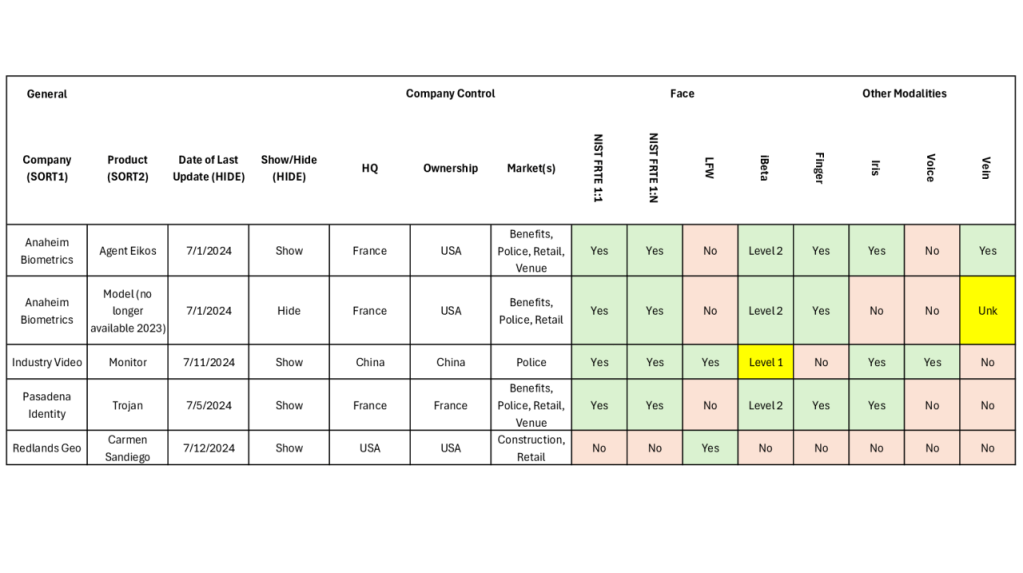
As you can probably guess from the title, the tips in question are Excel-specific and relate to how I format my investigative workbooks. So they’re more nuts-and-bolts than high-level.
Despite this, early this morning I reshared those Bredemarket tips on my personal profile, just in case someone from Firm X happened to take a look at my LinkedIn profile. (They didn’t.)
Sadly, my wildebeest discussion of competitive analysis confined itself to nuts and bolts, and I needed a higher level discussion of how Bredemarket performs analysis for its clients.
It turns out I had already written it, when I described to Firm X how I intended to perform competitive analysis for them.
So here’s a redacted version of the competitive analysis OKR I prepared for Firm X, last revised yesterday, but never shared with the firm.
Using techniques developed at IDEMIA, Incode, and Bredemarket:
- Identify true competitors (approximately 20 possible competitors identified as of 11/26/2024).
- Perform feature comparison to indicate closeness of competitors, [FIRM] strengths, and [FIRM] failures.
- Identify key collateral required for each competitor (SWOT analysis, one-page battlecard, messaging/positioning document).
- Identify key competitors (high, medium, low).
- Complete collateral for high competitors.
- Complete collateral for medium competitors.
- Complete collateral for low competitors.
- Revisit collateral on a regular cadence, revise as necessary.
- Identify new competitors as necessary.
Now that I have the chance, let me elaborate on two of the points.
Identify true competitors
Have you ever heard a company say “we have no competitors”?
Bull.
Every single company that sells something ALWAYS has one competitor: “do nothing.”
And many companies have competitors that are not always apparent at the surface. For example, your average U.S. satellite television network (CBS, Fox News, Game Show Network, whatever) doesn’t only compete with other satellite television networks, but also competes with YouTube, TikTok, and other sources of information.
But no company has a truly infinite number of competitors. Yes, one could argue that a View-Master is a legitimate competitor to a U.S. satellite television network…but how much market share will View-Master steal from CBS?

So you need to identify the POSSIBLE competitors to your product, and then see if they TRULY compete.
Perform feature comparison
One way to do this is to compare the features of your product against the features of other firms’ products.
But you have to do it right.
If you are completely enamored with your product, you may choose to ONLY list the features that YOUR product has, and compare only those features against possible competitors. By definition, your product will have every feature in the comparison, and therefore it’s the best product ever.
Perhaps you can start with this…but then you need to look at your competitors’ features and determine which ones your product DOESN’T have.
For example, your product may be the best on-premise solution ever, but if your competitors offer SaaS implementations and you don’t, that’s one way in which your product sucks.
Once you have a true feature comparison, you can proceed with ranking the competitors as high, medium, or low, then with enunciating your benefits and closing your weaknesses.
How do my competitive analysis strengths benefit you?
If your knowledge of your competitors is lackluster, perhaps I can help.
- Even though my consulting contract didn’t explicitly allow it, I regularly fed one of my consulting clients information about its major competitor. This allowed the client to respond to questionable statements the competitor made.
- Two of my employers directly benefited by my competitive analysis, not only by identifying key strengths and weaknesses of their competitors, but also by knowing who their competitors actually were. One company’s worldwide sales force competed against dozens upon dozens of competitors, and the headquarters had no idea…until I asked the salespeople.
Does your firm want to employ me to spearhead your analysis services? Contact me on LinkedIn.
Or, if you only require my services on a consulting basis, contact me through Bredemarket’s “CPA” page. Unless I’m employed by one of your competitors.


 Bredemarket
4 Comments