
A single loss does not define your entire life. As the sporting world teaches us, Olympic losers and other competitive losers can become winners—if not in sports, then elsewhere.
The human drama of athletic competition
When I was young, the best variety show on television didn’t involve Bob Mackie dresses. It instead featured Jim McKay, introducing the show as follows.
Spanning the globe to bring you the constant variety of sport…the thrill of victory…and the agony of defeat…the human drama of athletic competition…This is ABC’s Wide World of Sports!
A technological marvel when originally introduced, this variety show brought sporting events to American viewers from all over the world.
And these viewers learned that in competitions, there are winners and losers.
But since Wide World of Sports focused on the immediate (well, with a bit of tape delay), viewers never learned about the losers who became winners.

Jim McKay and his colleagues were not retrospective, but were known for the moment. In one instance that was NOT on tape delay, Jim McKay spoke his most consequential words, “They’re all gone.”
Vinko Bogataj
(Note: some of this content is repurposed because repurposing is cool.)
Turning to less lethal sporting events, remember Jim McKay’s phrase “the agony of defeat”?
For American TV watchers, this phrase was personified by Vinko Bogataj.

Hailing from a country then known as Yugoslavia (now Slovenia), Bogataj was competing in the 1970 World Ski Flying Championships in Oberstdorf, in a country then known as West Germany (now Germany). His daughter described what happened:
It was bad weather, and he had to wait around 20 minutes before he got permission to start. He remembers that he couldn’t see very good. The track was very bad, and just before he could jump, the snow or something grabbed his skis and he fell. From that moment, he doesn’t remember anything.
While Bogataj suffered a concussion and a broken ankle, the accident was captured by the Wide World of Sports film crew, and Bogataj became famous on the “capitalist” side of the Cold War.
And he had no idea.
“He didn’t have a clue he was famous,” (his daughter) Sandra said. That changed when ABC tracked him down in Slovenia and asked him to attend a ceremony in New York to celebrate the 20th anniversary of “Wide World of Sports” in 1981.
At the gala, Bogataj received the loudest ovation among a group that included some of the best-known athletes in the world. The moment became truly surreal for Bogataj when Muhammad Ali asked for his autograph.
Bogataj is now a painter, but his 1970 performance still follows him.
Over 20 years after the infamous ski jump, Terry Gannon interviewed Bogataj for ABC. As Gannon recounted it on X (then Twitter), Bogataj “got in a fender bender on the way. His first line..’every time I’m on ABC I crash.'”
Some guy at the Athens Olympics in 2004
Since the Paris Olympics is taking place as I write this, people are paying a lot of attention to present and past Olympics.
The 2004 Olympics in Athens was a notable one, taking place in the country where the original Olympics were held.
But during that year, people may have missed some of the important stories that took place. We pay attention to winners, not losers.
Take the men’s 200 meter competition. It began with 7 heats, with the top competitors from the heats advancing.
Within the 7 heats, Heat 4 was a run-of-the-mill race, with the top four sprinters advancing to the next round. If I were to read their names to you you’d probably reward me with a blank stare.
But if I were to read the 5th place finisher to you, the guy who failed to advance to the next round, you’d recognize the name.
Usain Bolt.
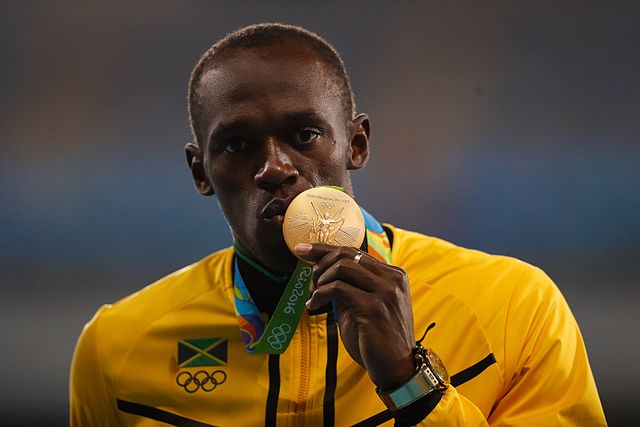
He did a little better at subsequent Olympics.
Some other guy at the Athens Olympics in 2004
KBWEB Consult tells the story of another competitor in the same 200 meter event in Athens. Chris Lambert participated in Heat 3, but didn’t place in the first four positions and therefore didn’t advance.
Nor did he place in the fifth position like Usain Bolt did in Heat 4.
Actually, he technically didn’t place at all. His performance is marked with a “DNF,” or “did not finish.”
You see, at about the 50 meter point of the 200 meter event, Lambert pulled a hamstring.
And that ended his Olympic competition dreams forever. By the time the Olympics were held in Lambert’s home country of the United Kingdom in 2012, he was not a competitor, but a volunteer for the London Olympics.

But Lambert learned much from his competitive days, and now works for Adobe.
KBWEB Consult (who consults on Adobe Experience Manager implementations) tells the full story of Chris Lambert and what he learned in its post “Expert Coaching From KBWEB Consult.”

A final thought
I haven’t done one of these in a while, but it’s important to remember that just because you lost a particular competition doesn’t mean that all is lost. We need to remember this whether we are a 200 meter runner who didn’t advance from their heat, or whether we are a job applicant receiving yet another “we are moving in a different direction” form letter.
In the meantime, take care of yourself, and each other.


 Bredemarket