
The 438 U.S. federal agencies (as of today) probably have over 439 different security requirements. When you add state and local agencies to the list, security compliance becomes a mind-numbing exercise.
- For example, the U.S. Federal Bureau of Investigation has its Criminal Justice Information Systems Security Policy (version 5.9 is here). This not only applies to the FBI, but to any government agency or private organization that interfaces to the relevant FBI systems.
- Similarly, the U.S. Department of Health and Human Services has its Health Insurance Portability and Accountability Act (HIPAA) Security Rule. Again, this also applies to private organizations.
But I don’t care about those. (Actually I do, but for the next few minutes I don’t.) Instead, let’s talk FedRAMP.
Why do we have FedRAMP?
The two standards that I mentioned above apply to particular government agencies. Sometimes, however, the federal government attempts to create a standard that applies to ALL federal agencies (and other relevant bodies). You can say that Login.gov is an example of this, although a certain company (I won’t name the company, but it likes to ID me) repeatedly emphasizes that Login.gov is not IAL2 compliant.
But forget about that. Let’s concentrate on FedRAMP.
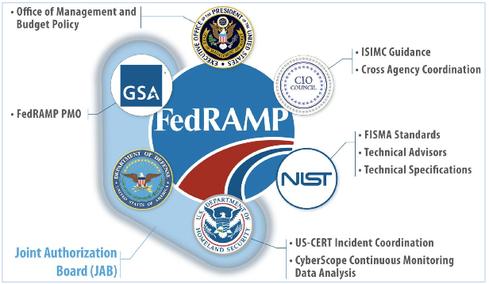
The Federal Risk and Authorization Management Program (FedRAMP®) was established in 2011 to provide a cost-effective, risk-based approach for the adoption and use of cloud services by the federal government. FedRAMP empowers agencies to use modern cloud technologies, with an emphasis on security and protection of federal information. In December 2022, the FedRAMP Authorization Act was signed as part of the FY23 National Defense Authorization Act (NDAA). The Act codifies the FedRAMP program as the authoritative standardized approach to security assessment and authorization for cloud computing products and services that process unclassified federal information.
From https://www.fedramp.gov/program-basics/.
Note the critical word “unclassified.” So FedRAMP doesn’t cover EVERYTHING. But it does cover enough to allow federal agencies to move away from huge on-premise server rooms and enjoy the same SaaS advantages that private entities enjoy.

Today, government agencies can now consult a FedRAMP Marketplace that lists FedRAMP offerings the agencies can use for their cloud implementations.
A FedRAMP authorized product example
When I helped MorphoTrak propose its first cloud-based automated biometric identification solutions, our first customers were state and local agencies. To propose those first solutions, MorphoTrak partnered with Microsoft and used its Azure Government cloud. While those first implementations were not federal and did not require FedRAMP authorization, MorphoTrak’s successor IDEMIA clearly has an interest in providing federal non-classified cloud solutions.
When IDEMIA proposes federal solutions that require cloud storage, it can choose to use Microsoft Azure Government, which is now FedRAMP authorized.

It turns out that a number of other FedRAMP-authorized products are partially dependent upon Microsoft Azure Government’s FedRAMP authorization, so continued maintenance of this authorization is essential to Microsoft, a number of other vendors, and all the agencies that require secure cloud solutions.
They can only hope that the GSA Inspector General doesn’t find fault with THEM.
Is FedRAMP compliance worth it?
But assuming that doesn’t happen, is it worthwhile for vendors to pursue FedRAMP compliance?
If you are a company with a cloud service, there are likely quite a few questions you are asking yourself about your pursuits in the Federal market. When will the upward trajectory of cloud adoption begin? What agency will be the next to migrate to the cloud? What technologies will be migrated? As you move forward with your business development strategy you will also question whether FedRAMP compliance is something you should pursue?
The answer to the last question is simple: Yes. If you want the Federal Government to purchase your cloud service offering you will, sooner or later, have to successfully navigate the FedRAMP process.
From https://www.mindpointgroup.com/blog/fedramp-compliance-is-it-worth-it.
And a lot of companies are doing just that. But with less than 400 FedRAMP authorized services, there’s obviously room for growth.

 Bredemarket
2 Comments