
On Friday, I shared a Kaye Putnam video on my Bredemarket LinkedIn page.

While I won’t go into all of the video details here (you should spend a few minutes and watch Putnam’s video yourself), one of the points that Putnam made was that the best content creators need to differentiate themselves from commodity content providers—in other words, to “be irreplaceable.”
If it’s not obvious how your product or service is wildly different, not just better, your ideal clients will resort to looking at you like a commodity.
Kaye Putnam, from the transcript to https://www.youtube.com/watch?v=jNGos1kVIdM
One of the ways in which content creators can differentiate themselves from their competition is to have a unique process.
In addition to having the emotional appeal and positioning that we already talked about, you can employ tools like having a proprietary process. A unique way of achieving a desired result.
Kaye Putnam, from the transcript to https://www.youtube.com/watch?v=jNGos1kVIdM
I’d like to look at one such process, the process in which a content creator collaborates with a client, but I’d like to take a look at how two very different content creators achieve the same outcome.
How Bredemarket collaborates with clients
One of the many differentiators between Bredemarket and its marketing and writing competitors is the way that Bredemarket kicks off projects.
Before I work with you, I ask a series of questions to better understand what you need.
(UPDATE OCTOBER 23, 2023: “SIX QUESTIONS YOUR CONTENT CREATOR SHOULD ASK YOU IS SO 2022. DOWNLOAD THE NEWER “SEVEN QUESTIONS YOUR CONTENT CREATOR SHOULD ASK YOU” HERE.)

Now these are not all of the questions that I ask. After all, my process is, um, “Bredemarket-developed.” (I avoid the word “proprietary” because of its negative connotations.) But the limited number of questions that I did share suggests how I try to understand you. Why you do what you do. How you do it. And so forth.
(If you are interested in this topic, I have written an entire e-book focused on the first six questions that I ask you. To download the e-book, visit my blog post “Six Questions Your Content Creator Should Ask You: the e-book version.”)

In true Putnam manner, I approach this entire process as a Sage, or someone who imparts wisdom which, when combined with your wisdom, results in an effective piece of content.

But not everyone is a Sage, and other content creators approach collaboration differently.
How Paso Artis collaborates with clients
As I’ve frequently said, my primary emphasis is words. My graphic execution capabilities are somewhat limited.

But there are many, many people who have better graphic execution capabilities than I do.
One such person is the artist behind Paso Artis.
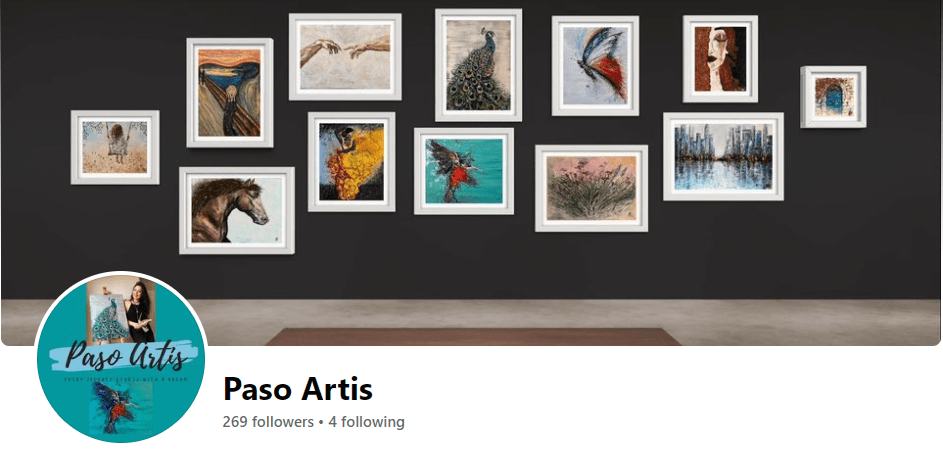
Now I don’t know Paso Artis’ personal archetypes, but I’d be willing to bet that her primary archetype isn’t Sage. The obvious guess for her primary archetype is “Creator.”
Get ready to celebrate the power of your creative brand archetype! Whether you resonate with being an Artist, musician, writer, dreamer, builder, or designer, your brand has the incredible ability to amaze and inspire others.
When customers encounter your creative brand, they can’t help but feel captivated. They look at your work and think, “I want to be able to do what they can.” Your brand ignites a spark of inspiration and ignites the imagination within those who connect with it.
One of your innate advantages as a creative brand is your boundless creativity and imagination. You possess the unique ability to see the world in a different light, to think outside the box, and to breathe life into your visions.
Kaye Putnam, from https://www.kayeputnam.com/brand-archetype-creator/
A few of you may recall that I initially thought that I was a “Creator,” until I realized that this archetype applies more to imagery rather than words. And not stick figures.
Despite our vast differences, Paso Artis and Bredemarket have one similarity.
- We both work together with our clients to create a piece of content that satisfies the clients’ needs.
- With Bredemarket, it’s a written piece of content.
- With Paso Artis, it’s a custom painting.
But because Paso Artis is…well, an artist, she doesn’t use Sage-like words and tables and bullet points to describe her client collaboration process. The Paso Artis-developed (again, I don’t like the word “proprietary”) collaboration process is described much more…artistically.
As an artist, I do feel the responsibility and privilege of taking a vision and turning it into a painting that will hang on the wall for years and be seen every day and regarded with affection.
Don’t be scared of handing over your dream to me.
In order to achieve a happy outcome, you and I will work together.
From https://www.facebook.com/paso.artis/about_details
Note that Paso Artis uses some words that Bredemarket never uses, such as “affection” and “dream.” Now I might use “vision” and “scared” in the proper context, but most of my clients and prospects do not dream of having their customers regard their products and services, or their blog posts or white papers, with affection. Even the Bredemarket client who chose to “truly say thank you for putting these (proposal) templates together” didn’t get affectionate about them. I mean, I love Microsoft Word, but I don’t LOVE Microsoft Word.
So Bredemarket and Paso Artis use a different vocabulary. This happens to come back to another point that Putnam made, to speak the language of your clients.
If you only know Italian and your ideal clients are speaking French, you might get a few people that understand what you mean, but it’s not going to have the transformative effect that we’re looking for. You want to learn to be fluent. In the decision making language of your ideal clients.
Kaye Putnam, from the transcript to https://www.youtube.com/watch?v=jNGos1kVIdM
Marketers, imagine if you will a possible persona for a Paso Artis prospect.

“Jay” is a homeowner who loves art and desires a particular type of painting for his home, but does not have the artistic talent to paint it himself. Ideally, the completed painting will be one that brings Jay delight when he sees it in his home, and will also delight his guests. But can he trust anyone to realize his dream?
So Paso Artis (who has years of marketing experience in her day job work) knows that she has to address Jay’s pain points. She first does this by addressing them in her “About” text (“Don’t be scared of handing over your dream to me”), but then addresses them more deeply during her consultation with Jay.
I have never performed a competitive analysis of artists who respond to commission requests, but I’d guess that some are better at collaborating with clients than others.
And the ones that collaborate well earn a positive reputation, which translates to increased revenue over those who don’t collaborate well.
How should YOU collaborate?
But of course Bredemarket doesn’t matter, and Paso Artis doesn’t matter. You matter.
When you collaborate with a partner, either one in which the partner provides a product or service to you, or you provide a product or service to the partner, make sure that both of you are on the same page (or easel) before launching into the work project.
And if you have a dream for a painting, contact Paso Artis via her Facebook page.
And if you want your blog posts, white papers, case studies, and other content to be regarded with affection (or something like that), contact Bredemarket.
- Email me at john.bredehoft@bredemarket.com.
- Book a meeting with me at calendly.com/bredemarket.
- Contact me at bredemarket.com/contact/.

 Bredemarket
2 Comments