
(Imagen 4)
Unless you’re in the surveillance industry, surveillance sounds like a dirty word. I once knew an identity/biometric CEO who forcefully declared that HIS company would NEVER work in the surveillance industry.

But as Goddard Technologies notes, surveillance can be useful even if you’re NOT chasing bad people.
But before I describe how, I’m going to reveal my age.
Kennedy (John) William (Smokey) Gordy
Let’s talk about a singer who went by the name Rockwell. This was supposedly to conceal the fact that his last name was Gordy (he is Berry’s son). But he didn’t really conceal the fact that one of the uncredited backup vocalists on his wonderful one hit was a man named Michael Jackson. This was in the 1980s, when Michael Jackson was kinda sorta popular. OK, now do you remember the song?
This excerpt from the lyrics provides the sinister tone of the song:
People call me on the phone, I’m trying to avoid
But can the people on TV see me, or am I just paranoid?
But that was the 1980s, when there was always a person in the surveillance loop. Even if there was a video camera hidden in Rockwell’s shower, some person was looking at the feed.
Things have changed.
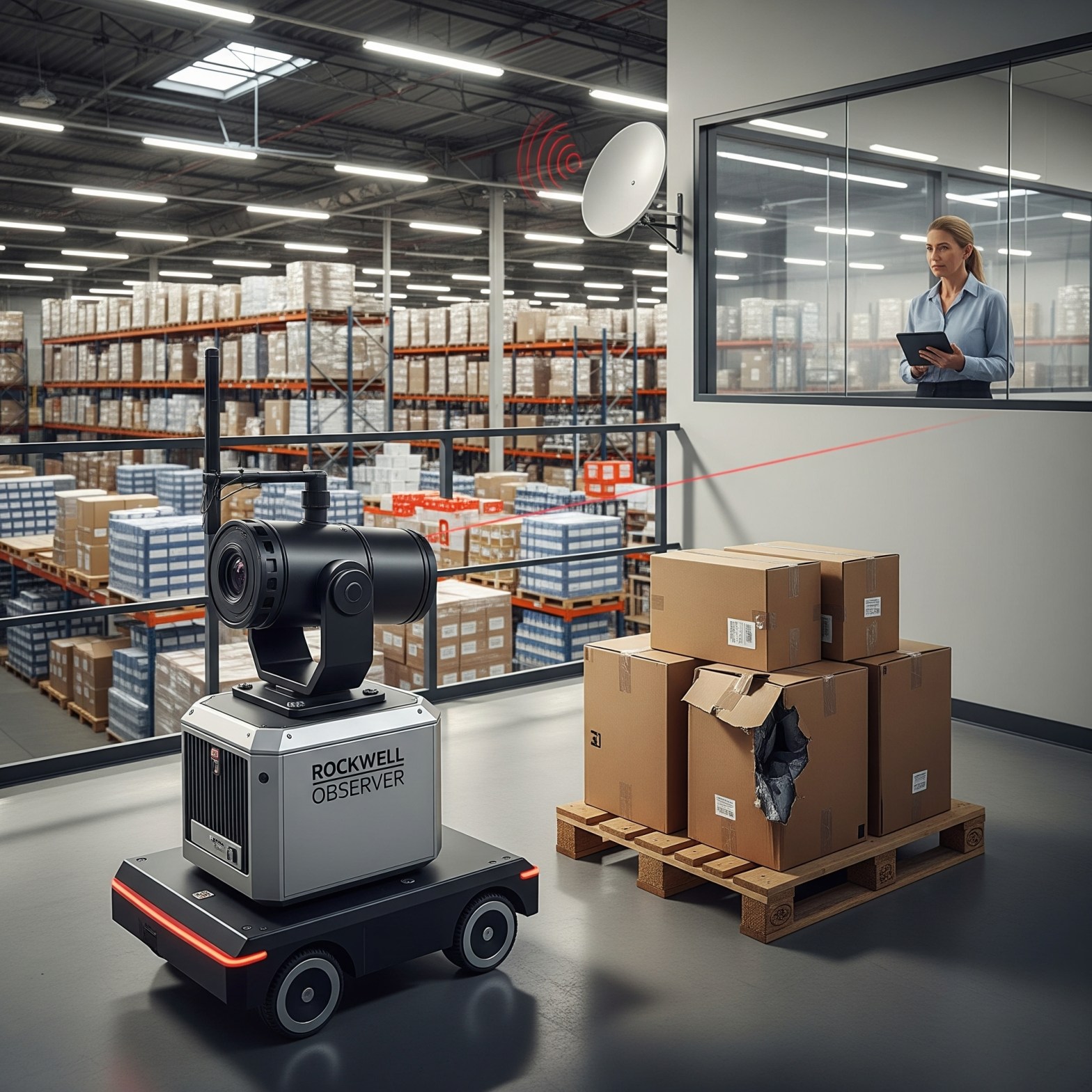
Goddard Technologies’ “The Rise of Robotic Observers”
Now non-person entities (NPEs) are no longer the stuff of science fiction, and they can do things that only humans could do 40 years ago.
Sandra Krombacher shared one example from a LinkedIn article by Jon Kaplan of Goddard Technologies.
Kaplan’s theme:
“While much of the attention has gone to robots that do something (cleaning, welding, lifting), there’s a quieter, equally important shift happening: the rise of robots that observe.”
But what do they observe?
“These robots navigate environments, gather data, and report back. Think of them as mobile sensors with wheels, legs or propellers that identify open doors, check for damage, verify inventory, or confirm environmental conditions.”
Kaplan then notes that there are human beings that perform similar tasks, and that therefore these observer bots “align with how many industrial jobs actually work.” After the observations are collected, then humans—or perhaps other bots—can act upon the observations.
Does this affect how you perceive non-person entities? How do you feel about non-person entities that merely collect data for others to act? This is technically “surveillance,” but it could potentially reduce costs, increase profits, or even save lives.
Do you sell robotic observers, or something equally important?
Jon Kaplan used a LinkedIn article to tell his story about Goddard Technologies’ activities with observing robots.
But maybe your firm has your own story to tell.

Why haven’t you written a LinkedIn article about your product? This lets you reach B2B prospects who are more likely on LinkedIn than on TikTok. In fact, I wrote a LinkedIn article about LinkedIn articles. (I wrote it so long ago that I only asked my clients six questions rather than seven questions.) And I’ve also written LinkedIn articles for Bredemarket clients.
Do you need help in writing that LinkedIn article that tells the world about your product? Maybe you could become one of my clients, since I help create content for tech marketers. Contact me.
 Bredemarket