
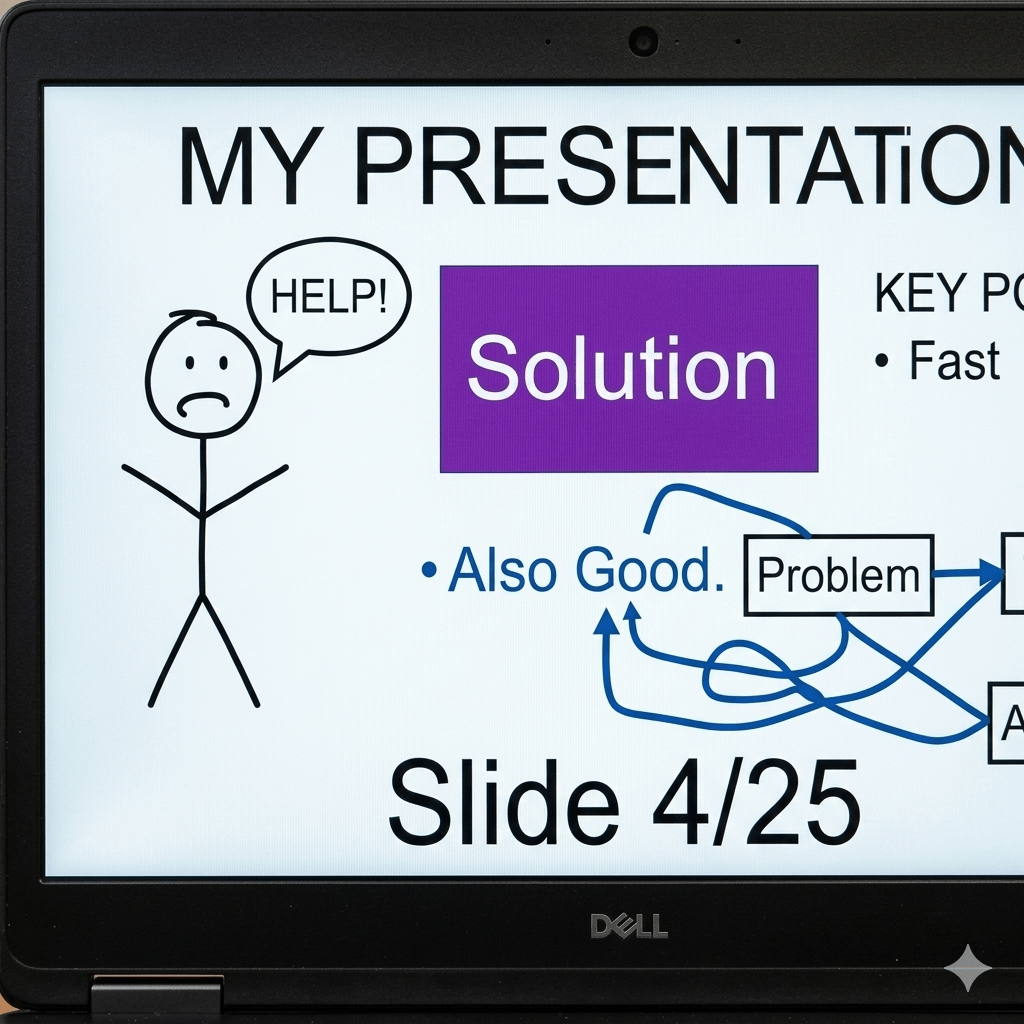
Depending upon your talents and resources, your company may choose different ways to tell critically important stories to your prospects. But how do you get there?
Early this week, one of Bredemarket’s clients expressed an urgent need for a story. My job was to figure out the concept and pass it on to a talented person inside the company who would use my concept to create the final version.
Now I had no idea what format the final story would take. An infographic? A video? Something else?

But my concept didn’t need to be in the final format. It just had to contain the concept.
For all the client cared, I could have sketched the concept out in Microsoft Excel. Which works great for storyboards, especially when the story is fluid and needs to be re-sorted.
In the end, I used a different Microsoft product—PowerPoint. Not that it mattered.

When working with creative talent, you have to give them enough of your intent without constraining them. And I definitely did not constrain.
- My PowerPoint used unformatted slides and default fonts.
- The graphic concept that was central to the entire story consisted, in my concept, of three boxes with words in them. Later it became four boxes.
- I used Google Gemini to create two subordinate concept images, but added indicators to show they should NOT be used. Even if the images were spectacular (they weren’t), we all know that my client couldn’t copyright them.
- After I was supposedly done, I took one last pass through the slides and removed every unnecessary word.
I can’t share what happened after I completed the concept, but the creative talent had enough information to move forward.
And I saved my client a lot of time by performing the initial conceptual work so the client could execute immediately.
And that’s what matters.

 Bredemarket