
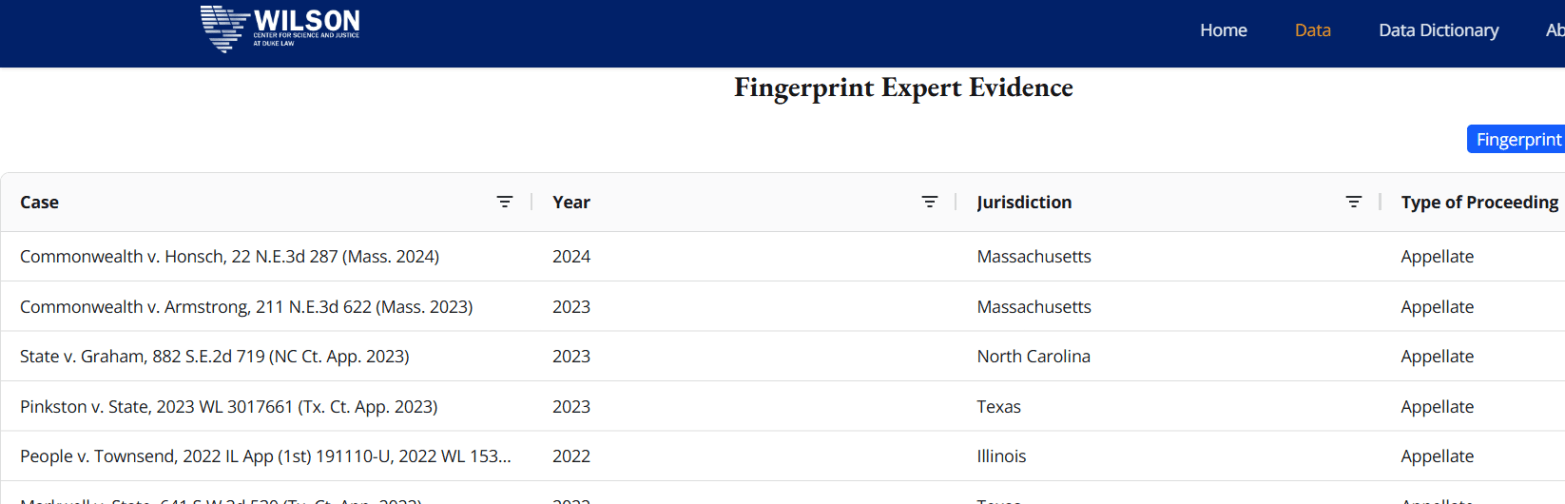
For…a long time I’ve been talking about whether fingerprint evidence is accepted in court. But until now I never had access to an easy-to-use database of court cases.
Mike Bowers shared a release from the Wilson Center for Science and Justice at Duke Law, “New Database Documents a Century of Court Decisions on Forensic Expert Evidence Testimony.”
The fingerprint database can be accessed here.
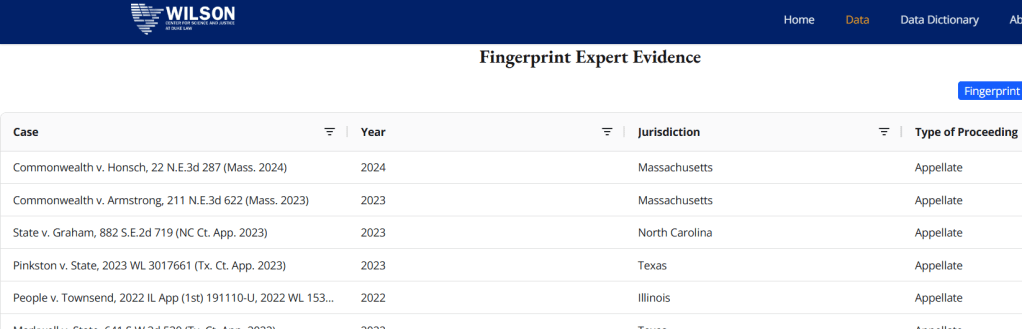
Here’s an example of the case details for the (current) most recent record:
Case
Commonwealth v. Honsch, 22 N.E.3d 287 (Mass. 2024)
Year
2024
Jurisdiction
Massachusetts
Type of Proceeding
Appellate
Other fields
CourtSupreme Judicial Court of Massachusetts, Hampden
Expert Evidence Ruling Reversing or Affirming on AppealAdmitted
RulingCorrect to admit
Type of EvidenceFingerprint
Defense or Prosecution ExpertProsecution
Summary of Reasons for Ruling
The Commonwealth here presented two latent print analysts as experts. One multiple times that it was his “scientific opinion” that there were three latent prints that were “identified to” the palms of the defendant. The term “scientific” to describe his opinion “arguably verged on suggesting that the ACE-V process is more scientific than warranted,” and there was one instance in which Dolan testified without using the term “opinion.” The court concludes that there was no error because, “viewed as a whole,” his testimony was largely expressed in terms of an “opinion” and his testimony did not claim that the ACE-V process was infallible or absolutely certain.
On the other hand, Pivovar testified that she (i) “identified [a palm print from one of the garbage bags and the print of the defendant’s left palm] as originating from the same source”; (ii) “identif[ied] [another latent print] and the right palm print of [the defendant] as being the same, they originated from the same source”; and (iii) “identif[ied] the [third latent print] as originating from the same source as the right palm of [the defendant] that [she] compared it to.” Pivovar did not frame her testimony in terms of an “opinion” and expressed the identification of the defendant with certainty. This was error. However, the court concluded that Pivovar’s testimony did not likely influence the jury’s conclusion. Defense counsel countered the notion that individualization under the ACE-V methodology is infallible by cross-examining Pivovar on the subjectivity of latent print analysis, the fact that two prints are never identical, and a recent incident in which the Federal Bureau of Investigation erroneously identified a suspect based on an incorrect latent print analysis. The defendant also presented an expert detailing the risks of cognitive bias in latent print analysis. Additionally, the Commonwealth’s other latent print examiner, Dolan, testified as to the same findings as Pivovar. If Pivovar’s testimony had been properly framed as an opinion, there still would have been strong evidence that the prints found at Elizabeth’s crime scene originated from the defendant. Thus, even though we determine that Pivovar’s testimony was erroneously presented as fact, the error did not create a substantial likelihood of a miscarriage of justice.
Admissibility StandardLanigan-Daubert
Lower Court HearingN
Discussion of 2009 NAS ReportY
Discussion of Error Rates or ReliabilityN
Frye RulingN
Limiting Testimony RulingN
Language Imposed by Court to Limit TestimonyN
Ruling Based in Prior PrecedentY
Daubert FactorsN
Ruling on Qualifications of ExpertN
Ruling on 702(a)N
Ruling on 702(b)N
Ruling on 702(c)N
Ruling on 702(d)N
Notes—
Good resource to keep in mind.

 Bredemarket