
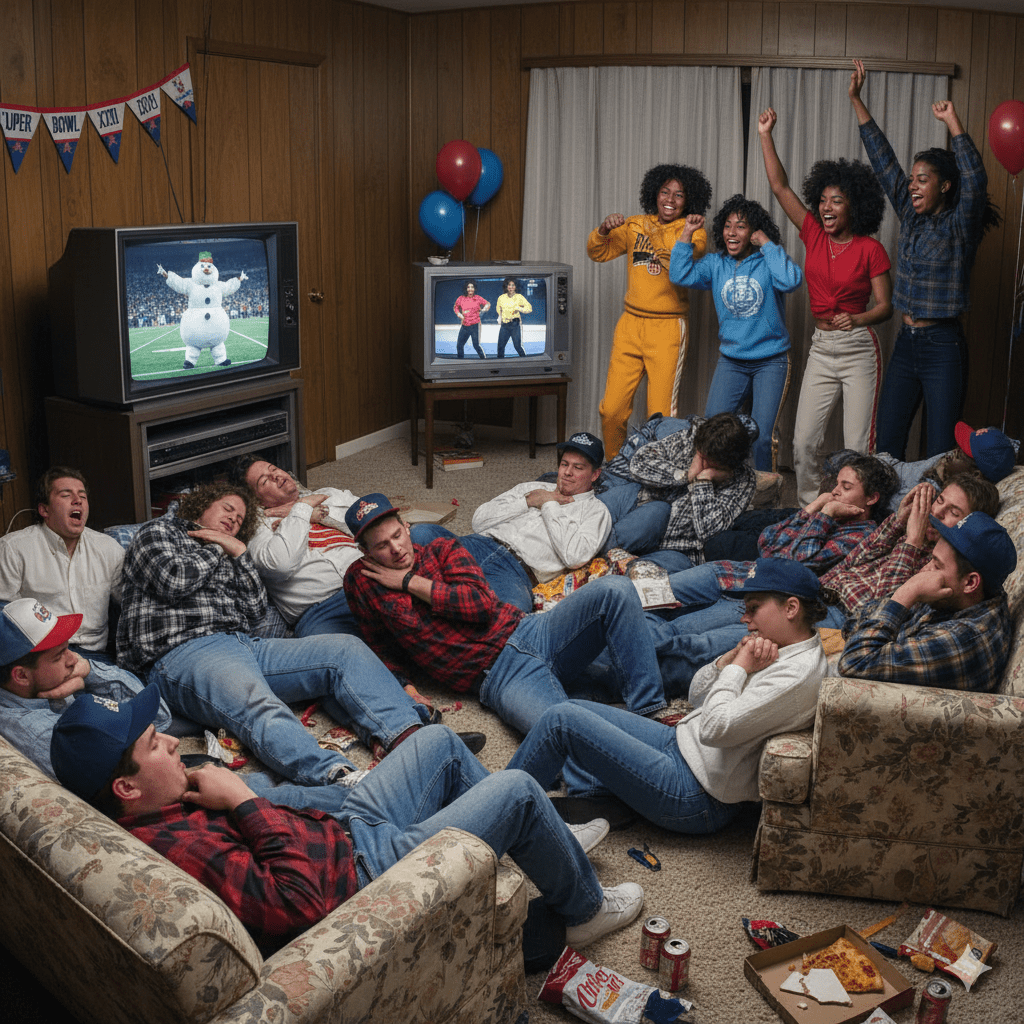
Because of something that happened during halftime at the 2026 Super Bowl, a lot of people are looking at something that happened during halftime at the 1992 Super Bowl.
You know, the story about how NO ONE watched the official 1992 halftime show and EVERYONE watched an unofficial one.
Except…that’s not what happened.
Marching bands at halftime
I was in my high school marching band, initially as a flute player, later as a drum major. I therefore performed in multiple football game halftime shows, entertaining the crowd with such classics as a Star Wars medley and a marching band arrangement of “Disco Duck.” (Cara and Jackie remember that one.)
And that was pretty much par for the course for football halftime shows. Not just at the high school level.
For example, let’s take a look at the Super Bowl. I will choose…Super Bowl XXVI.
It was a little fancier than my high school. Gloria Estefan sang during halftime. But the show also featured figure skaters Brian Boitano and Dorothy Hamill, the 1980 U.S. Olympic Hockey Team…and the University of Minnesota Marching Band. The theme was “Winter Magic.” Not sure how Miami-associated Estefan (who didn’t even appear until 10 minutes in) fit the theme.
Back in those days, the Winter Olympics were held on leap years, the same as the Summer Olympics. And therefore the Winter Olympics were just weeks away on CBS, the same network airing the Super Bowl. So this halftime show, in the middle of the Super Bowl, was guaranteed to get high viewership.
But not as high as expected.
The fourth network
Back when I was styling in my marching band uniform, the United States was dominated by three commercial television networks. A few years later a fourth network emerged, Fox.
Back in those days the name “Fox” was associated with innovation, and the fourth network definitely innovated with shows like the anti-Cosby “Married…with Children.” There was also a variety show, “The Tracey Ullman Show,” which spun off a cartoon show, The Samsons or something. And there was also comedy show with mostly black actors called “In Living Color.”
But the Big Three had one thing that Fox didn’t: NFL football. Those agreements were locked in place: the NFC on CBS, the AFC on NBC, and Monday Night Football on ABC. By 1985, Super Bowl telecasts began to rotate between these three networks, with CBS getting the 1992 slot.
Meanwhile, those rambunctious Fox folks were cooking up a surprise.
“During In Living Color’s first season, a marketing impresario named Jay Coleman approached Fox with an idea that would draw even bigger ratings and stick it to CBS, the NFL rights holder and Super Bowl carrier that Murdoch had in his sights: a special episode of In Living Color that would air opposite the Super Bowl intermission.”
An audacious idea, which they executed in a way to ensure that people could turn to Fox at halftime, then turn back to CBS for the second half of the game.
“[Jim] Carrey started by revealing a 26-minute countdown clock at the left bottom corner of the screen that would let viewers know when to switch back for the second half. “You won’t miss any of the senseless brutality!”
And they were off with a show that blew the marching band away in terms of creativity.
But not in terms of ratings.
CBS won the time slot
The way the story is told today, you would think no one watched Estefan et al.
But statistics show that 79 million people watched the Super Bowl broadcast. 22 million watched In Living Color at halftime.
It’s uncertain how many people watched the Winter Magic portion of the CBS broadcast, but it’s quite possible that as many as 57 million stuck around.
Read that again.
57 million people.
Which is much more than 22 million people.
Of course, maybe all 57 million people didn’t stick around. Perhaps everyone not watching the Homeboy Shopping Network used the time for a bathroom break.
But it’s safe to say that more than 22 million people kept their TVs on CBS during halftime. Probably many, many more.
So on the surface the counter programming failed.
However, 22 million people is a lot of people to lose. In a more recent example, 2026 Turning Point counter programming drew no more than 5 million viewers. Although to be fair, it wasn’t even on TV, but on something called Ew Tube or something like that. And who would watch something on a computer or a phone?
But let’s go back to 1992. Maybe the NFL show won the ratings, but “The Shield” was shamed into revamping next year’s show.
They decided to can the marching band and ONLY go with a singer.
Michael Jackson.
What does this mean for B2B sales?
I will admit that the Super Bowl story is an…um…engaging story. (You see what I did there.)

But in this case there truly is a lesson to be learned.
When battling against an established product, you don’t necessarily have to beat it. You just have to perform credibly.
But beware, because that may be enough for the established product to wake up and start innovating itself.

 Bredemarket