
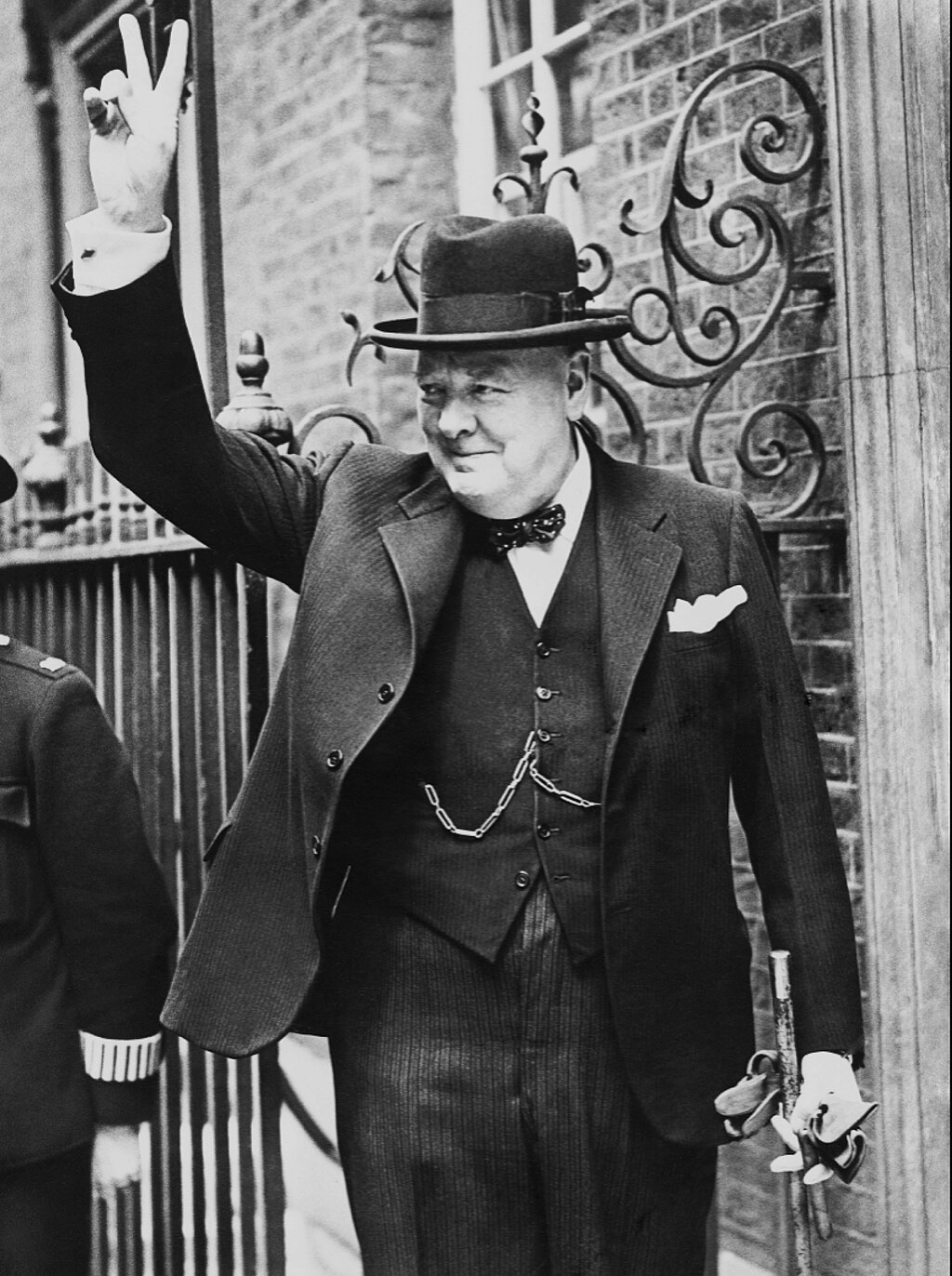
(Churchill image public domain)
And I thought tongue identification was weird.
Biometric Update reported that the Australian government is evaluating a solution that estimates age by gestures.
At first thought I didn’t get it. Holding two fingers up in the air could be a 1960s peace hand gesture or a 1940s victory hand gesture.
Obviously I needed to give this a second thought. So I went to Needemand’s page for BorderAge. This is what I found.
« L’internaute doit simplement effectuer 3 mouvements de la main et l’avant-bras devant la caméra de son écran (ordinateur, tablette, smartphone). En quelques secondes, il/elle vérifie son âge sans dévoiler son identité. »
Help me, Google Translate; you’re my only hope.
“The Internet user simply has to make 3 movements of the hand and forearm in front of the camera on their screen (computer, tablet, smartphone). In a few seconds, he/she verifies his/her age without revealing his/her identity.”
The method is derived from a 1994 scientific paper entitled “Rapid aimed limb movements: Age differences and practice effects in component submovements.” The abstract of the paper reads as follows:
“Two experiments are reported in which younger and older adults practiced rapid aimed limb movements toward a visible target region. Ss were instructed to make the movements as rapidly and as accurately as possible. Kinematic details of the movements were examined to assess the differences in component submovements between the 2 groups and to identify changes in the movements due to practice. The results revealed that older Ss produced initial ballistic submovements that had the same duration but traveled less far than those of younger Ss. Additionally, older Ss produced corrective secondary submovements that were longer in both duration and distance than those of the younger subjects. With practice, younger Ss modified their submovements, but older Ss did not modify theirs even after extensive practice on the task. The results show that the mechanisms underlying movements of older adults are qualitatively different from those in younger adults.”
So what does this mean? Needemand has a separate BorderAge website—thankfully in English—that illustrates the first part of the user instructions.

I don’t know what happens after that, but the process definitely has an “active liveness” vibe, except instead of proving you’re real, you’re proving you’re old, or old enough.
Now I’m not sure if the original 1994 study results were ever confirmed across worldwide populations. But it wouldn’t be the first scheme that is unproven. Do we KNOW that fingerprints are unique?
Another question I have regards the granularity of the age estimation solution. Depending upon your use case and jurisdiction, you may have to show that your age is 13, 16, 18, 21, or 25. Not sure if BorderAge gets this granular.
But if you want a way to estimate age and preserve anonymity (the solution blocks faces and has too low of a resolution to capture friction ridges), BorderAge may fit the bill.

 Bredemarket