
My last post included a fake press release with a fake quote from a fake CEO named Silas Phelps.
Some of you may have recognized the name. I’ll explain who Silas Phelps is, why he’s inconsequential, how his story (well, not HIS story) relates to a piece of music I shared in my last post…and what this all means for marketing writers.
A 19th century novel
For the rest of you, Phelps is a character who first appears in Chapter 31 of “The Adventures of Huckleberry Finn,” set in the antebellum era.
The title character has been traveling with a runaway slave named Jim, who has disappeared. When Huck went to look for him, he learned that Jim had been captured. Here is Huck in his own voice (he is the narrator of the novel):
Pretty soon I went out on the road, trying to think what I better do, and I run across a boy walking, and asked him if he’d seen a strange [REDACTED] dressed so and so, and he says:
“Yes.”
“Whereabouts?” says I.
“Down to Silas Phelps’ place, two mile below here. He’s a runaway [REDACTED], and they’ve got him.
The reader eventually meets Silas Phelps, and his family, and his extended family. But they are relatively minor in the story, as Huck continues “trying to think what I better do.”
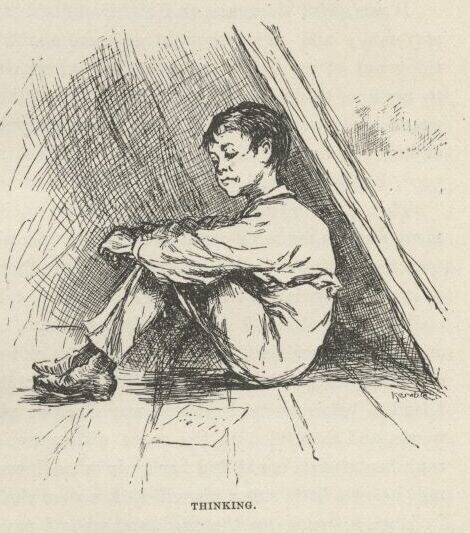
Because Huck knows that in the eyes of society, he is a terrible scoundrel.
And at last, when it hit me all of a sudden that here was the plain hand of Providence slapping me in the face and letting me know my wickedness was being watched all the time from up there in heaven, whilst I was stealing a poor old woman’s [REDACTED] that hadn’t ever done me no harm, and now was showing me there’s One that’s always on the lookout, and ain’t a-going to allow no such miserable doings to go only just so fur and no further, I most dropped in my tracks I was so scared.
Huck knows what he SHOULD do…but he doesn’t. Well, he STARTS to write a letter up north to let Jim’s owner know where he was…but then he looks at the paper.
It was a close place. I took it up, and held it in my hand. I was a-trembling, because I’d got to decide, forever, betwixt two things, and I knowed it. I studied a minute, sort of holding my breath, and then says to myself:
“All right, then, I’ll go to hell”—and tore it up.
And this is the end of the book, but not the end of the story.
- Clemens still had to wrap up all the loose ends of the story, and introduce some new ones (when Huck Finn finally meets Silas Phelps, he has to adopt the name “Tom Sawyer”), but it’s all inconsequential.
- I think I can give the ending away after over a century, but it turns out that Jim was already a free man, having been freed in Miss Watson’s will.
- And Huck was also free, because his tormenting father was dead (something Jim knew all along but kept from Huck at the time). Compared to these revelations, Silas Phelps’ story was truly inconsequential.
Huckleberry Finn’s declaration of what is right is central to the novel. While it was written years after the Civil War had ended, in some sense the Civil War has never ended.
To see another view of this pivotal statement in the novel, read this June 19, 2020 (geddit?) Facebook post by Brad Paisley.
A 21st century electronic song
The idea of a story reaching its climax long before its end stuck with me back when I wrote “For a Meaningful Apocryphal Animation” for the 2017 Ontario Emperor album “Drains to Ocean.”

The song, by the way, is about those fake inspirational stories. For example, if someone wrote up the story about the hiring manager who made a bunch of job applicants wait all day and hired the only one who stuck it out. These stories are never attributed to a reliable source, and in most cases they were probably made up. But someone is bound to take the fake story and put it to soothing music and create a video and get a lot of clicks. “For a Meaningful Apocryphal Animation” was meant to go with one of those fake stories, but I haven’t gotten around to writing the story yet.
And there’s also something musically going on.
When I wrote the song, I channeled my inward Samuel Clemens. Because Ontario Emperor is to music what Mark Twain is to literature. (Well, that’s what the marketing flack would say.)
If you examine the piece, it’s four minutes and thirty-five seconds long.
Which is almost two minutes longer than it should be.
By the time you get to the three percussive snaps at about the 2:40 mark, the piece is pretty much done.
Sure, it goes on for nearly two more minutes, and I play around with the melody for a bit, and I include the greatest musical fade in 21st century music (so the marketing flack says), but I’ve said all that I wanted to say.
Well, at least until the next song on the album, “Climbing.”
The 21st century marketing writer
But let’s return to text. Not novels, but marketing text.
When you write marketing text, you have one key point that you want to make.
- Some marketing “experts” say that you need to make the point in the beginning.
- Other “experts” say you need to save the point until the end.
- None of the “experts” say that your key point should be in the middle.
I don’t really care. If you want to make your point in the middle, using the preceding text to lead up to it, and using the following text to dispose of any other stuff, that’s fine with me.
Just make the point.

 Bredemarket