
As we close out 2023, I’ve been thinking about a lot of things.
Will 2024 be like 2021, in which the new year (2024) offers mimimal improvement over the preceding year (2023)? Reply hazy, try again later. (“And while tech layoffs slowed down in the summer and fall, it appears that cuts are ramping up yet again.”)
What new ways will we develop to better ghost people? Or will the old ways of ghosting continue to dominate the (lack of) conversation? (And if the person who ghosts is the ghoster, and the person who is ghosted is the ghostee…who is the ghost?)
Most importantly for this post, I’ve been thinking about the following: why are target audiences TARGETS, and why are they AUDIENCES? And is the term “target audience” the best description? (TL;DR: No.) If not, what’s a better description? (TL;DR: I don’t know.)
So let’s look at target audiences. And if you don’t mind, I’ve asked William Tell, Cheap Trick, Steve Dahl, Google Bard, Andrew Loog Oldham, and others to help me examine the topic, which will probably be Bredemarket’s last blog post of 2023.
What I’ve said about target audiences
Bredemarket has written a ton about the idea of a “target audience.” I have an information page devoted to target audiences, which cites a number of the posts I have written about target audiences. It’s even one of the seven sections of one of my e-books.
And now I’m thinking about changing it.

But first I’ll explain where I’m coming from. Rather than diving into great detail, I’ll take a more, um, targeted approach and just quote a bit from the relevant information page.
There are roughly 8 billion people in the world. Most businesses don’t care about 7.99999 billion of these people; the businesses only care about 0.00001 billion (or fewer) people who will buy or recommend the business’ product or service.
Your content (or proposal) needs to resonate with these people. The others don’t matter.
From https://bredemarket.com/target-audience/.
That part is true…to a, um, point. But the quote obscures a lot. And the phrase “target audience” obscures even more.
The problem with the phrase “target audience”
I first started questioning the phrase “target audience” when I read this post from the Daily Copywriting page on LinkedIn. I’ll quote the part that, um, resonated with me.
Stop talking to people like they’re targets, start talking to them like they’re humans.
From https://www.linkedin.com/posts/daily-copywriting_copywriting-tip-stop-talking-to-people-activity-7144365103054819328-vy33/.
Daily Copywriting’s use of the word “target” as a pejorative got me thinking about my fave phrase “target audience.”
Let’s start with the first word. At its worst, “target” implies something that you shoot, in a William Tell sort of way. If your weapon hits the target, you and your son don’t die. If your weapon misses low, you kill your son. Is that what we marketers do? Hopefully not.

Even at its best, “target” is just something that you get right. You’ve narrowed the 8 billion people to the few that really matter. So what?
Then we move to the second word of the fave phrase “target audience.” An audience is a group of people that sit in chairs while you perform your song and dance in front of them. (“These are the seven questions your content creator should ask you. Thank you for coming to my BRED talk.”)
- Sometimes the audience just sits. Not good.
- Sometimes the audience claps. A little better.
- If you’re the Beatles or Cheap Trick, the audience screams. But still not enough.
Clapping or screaming is nice, but this doesn’t count as true engagement. I mean, in a way it would be nice if you scream with joy at this post, but it counts for nothing if you don’t actually buy Bredemarket’s marketing and writing services.
I’m forced to admit that there was one time where someone truly engaged his target audience—and that was during Steve Dahl’s “Disco Demolition Night.”
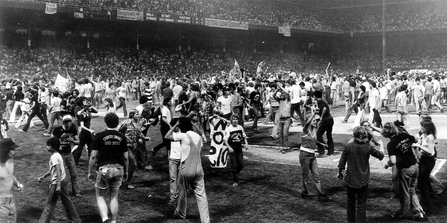
Dahl was not a disco fan, since he lost his WDAI radio job when his then-employer switched to a disco format. As a counter-reaction to disco, Dahl entertained baseball fans on Disco Demolition Night by destroying disco records between two games of a doubleheader. 7,000 fans stormed the field in delirious joy, wrecking the field, and the second game of the doubleheader was never played. This was NOT a good thing. But the White Sox survived, and even celebrated the 40th anniversary of the promotion. Dahl threw out the first pitch. Nothing exploded. But nothing was accomplished.
So if “target audience” isn’t the right term to use, what is?
The problem with the term “needy people”
I know that blogs are supposed to be the place where you mull about things and finalize them later, but sometimes I break the rules and mull about them BEFORE blogging about them. And that’s what I did when I reshared the Daily Copywriting post to the Bredemarket LinkedIn page, adding this comment:
Perhaps I should rework my phrase “target audience.”
From https://www.linkedin.com/posts/bredemarket_copywriting-tip-stop-talking-to-people-activity-7144742535775592448-UAGh/.
Hmm…”needy people”?
I’ll grant that “needy people” has a negative connotation, like the person who is sad when people forget their birthday. (Not “ghosting” per se, but perhaps a little “boo.”) But “needy people” is certainly better than “target audience.”
- “Needy” is stronger than “target.” Rather than just representing a demographic, it actually represents people who truly NEED things. Just because a company needs content for its website doesn’t necessarily mean that it needs Bredemarket. Many companies have their own people to create content.
- And for the reasons stated by Daily Copyrighting, “people” is stronger than “audience.” You are not a faceless audience that claps (or screams) when Bredemarket does its song and dance. You are people who work in a certain way, which I why I talk to people before creating content for them.
This “needy people” phrase sounded good a few days ago, but now that I’ve thought about it some more I see some problems with this formulation also. In addition to the negative connotations of the phrase, the mere fact that someone is “needy” doesn’t necessary mean that they will buy Bredemarket’s services. Take my identification of “needy people” from a few days ago:
My mini-survey shows that of the 40+ identity firms with blogs, about one-third of them HAVEN’T SAID A SINGLE THING to their prospects and customers in the last two months.
From https://bredemarket.com/2023/12/19/why-your-identity-company-isnt-saying-anything/
Yes, these companies are damaging their future prospects and need Bredemarket. But none of these companies has approached Bredemarket, or any other marketing and writing consultant, or their in-house people.
- Perhaps they don’t see the problem at all.
- Perhaps they see the problem, but don’t want to spend money (even a few hundred dollars) to fix it.
- Perhaps they see the problem but don’t consider it as critically important as the other problems they face. Rather than spending a few hundred dollars, some companies are saving millions of dollars by “rightsizing” by 10-20% and cutting marketing budgets. They’re just fine with spiderweb-covered blog pages.
Because “needy people” doesn’t capture my meaning, I’ll do the recommended thing and use this blog post to throw up another idea.
The problem with the term “hungry people”
My latest iteration of “target audience” is “hungry people.” I figure that unlike “needy people,” “hungry people” are more inspired to act on their needs. They don’t just clap or scream; they are motivated to search for something to eat.

Using my example of the non-blogging identity firms, perhaps some of those quiet firms are troubled by their lack of communication with their prospects and clients. Rather than doing nothing, these firms are ready to plug their communications gap. But will they plug it with healthy food, or with junk food?
Even without writers, companies can unleash a content creation boom with generative AI. By feeding the AI brand guidelines, target audience data, and product specifics, they can churn out blog posts, ad copy, product descriptions, and even social media snippets. This AI assistant generates captivating headlines, outlines engaging narratives, and drafts basic texts, all while maintaining brand voice and SEO optimization. AI handles the heavy lifting, freeing up resources for strategic planning and audience engagement, boosting content output from silence to symphony.
I know this may surprise you, but I didn’t write the paragraph above. Google Bard did. And perhaps some hungry companies will opt for the free route and let generative AI write their content rather than contracting or employing a content marketer. Silence to symphony for a $0 budget! I consider this bittersweet.
So “hungry” doesn’t quite cut it, since I seek the people who are not only hungry, but who will pay for quality fare such as Bredemarket’s marketing and writing services.
To be continued
In this case, the blog post IS a temporary expression of thought. I’ve determined that “target audience” is an imperfect phrase and that I need to replace it with SOMETHING, but I haven’t figured out what that “something” is yet.
Until I get a better idea, I’ll use “hungry people” in my internal work, but I won’t change my customer-facing work (such as the e-book) until I come up with an effective alternative to “target audience.”
And one more thing
And unless I get a sudden brainstorm, this will probably be the last Bredemarket blog post for 2023, and I’m currently ruminating about the first question I asked in this post regarding prospects for 2024. While there were some positive things that happened this year, the negatives during the last seven months tended to outweigh the positives. A lot of other people are also experiencing this, so I’m sharing this song for those who are glad that 2023 is almost over, and who hope that 2024 isn’t more of the same.
Happy New Year.

 Bredemarket
12 Comments