
In the course of writing something on another blog, I mentioned the following:
You see, my fingerprint experience was primarily rooted in the traditional 14 (yes, 14) fingerprint impression block livescan capture technology used by law enforcement agencies to submit full sets of tenprints to the U.S. Federal Bureau of Investigation (FBI), and state and local agencies that submit to the FBI.
From https://jebredcal.wordpress.com/2023/06/12/when-one-type-of-experience-is-not-enough/
I’d be willing to bet that the vast majority of you have ten fingers.
So why do tenprint livescan devices capture 14 fingerprint impression blocks?
Why 14 fingerprint impression blocks are as good as 20 fingers
It’s important to understand that tenprint livescan devices, which only began to emerge in the 1980s, were originally designed as an electronic way to duplicate the traditional inking process in which ink was placed on arrestees’ fingers, and the ink was transferred to a tenprint fingerprint card.
The criminal fingeprint card (and, with some changes, the applicant fingerprint card) looks something like this:

If you look at the lower half of the front of a fingerprint card, you will see 14 fingerprint impression blocks arranged in 3 rows.
- The first row is where you place five “rolled” (nail to nail) fingerprints taken from the right hand, starting with the right thumb and ending with the right little finger.
- The second row is where you place five rolled fingerprints from the left hand, again starting with the thumb and ending with the little finger.
So now you’ve captured ten fingerprints. But you’re not done. You still have to fill four more impression blocks. Here’s how:
Identification flat impressions are taken simultaneously without rolling. These are referred to as plain, slap, or flat impressions. The individual’s right and left four fingers should be captured first, followed by the two thumbs (4-4-2 method).
From https://le.fbi.gov/science-and-lab/biometrics-and-fingerprints/biometrics/recording-legible-fingerprints
To clarify, on the third row, for the large box in the lower left corner of the card, you “slap” all four fingers of the left hand down at the same time. Then you skip over the the large box on the lower right corner of the card and slap all four fingers of the right hand down at the same time. Finally you slap the two thumbs down at the same time, capturing the left thumb in the small middle left box, and the right thumb in the small middle right box.
Well, at least that’s how you do it on a traditional inked card. On a tenprint livescan device, you roll and slap your fingers on the large platen, without worrying (that much) about staying within the lines.
Why 14 fingerprint impression blocks are better than 20 fingers
So by the time you’re done, you’ve filled 14 fingerprint impression blocks by 13 distinct actions (the two slap thumbs are captured simultaneously), and you’ve effectively captured 20 fingerprints.
Why?
Quality control.
Because since every finger should theoretically be captured twice, the slaps can be compared against the rolls to ensure that the fingerprints were captured in the correct order.
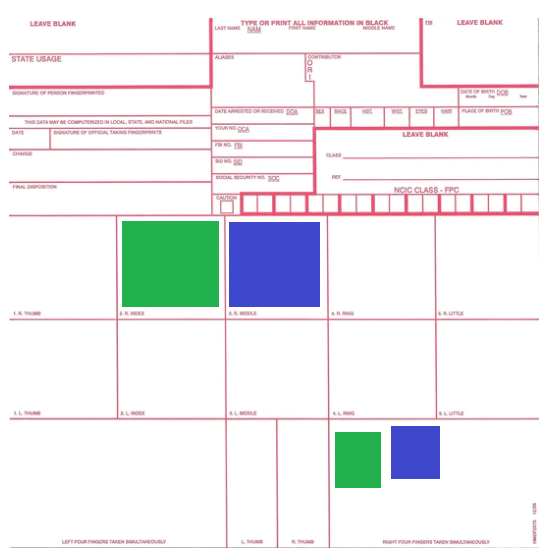
If you capture the rolled and slap prints in the correct order, then the right index finger (finger 2) should appear in the green area on the first row as a rolled print, and in the green area on the third row as a slap print. Similarly, the middle finger (finger 3) should appear in the blue areas.
If the green rolled print is NOT the same as the green slap print, or if the blue rolled print is NOT the same as the blue slap print, then you captured the fingerprints in the wrong order.
In the old pre-livescan days of inking, a trained tenprint fingerprint examiner (or someone who pretended to be one) had to look at the prints to ensure that the fingers were captured properly. Now the roll to slap comparisons are all done in software, either at the tenprint livescan device itself, or at the automated fingerprint identification system (AFIS) or the automated biometric identification system (ABIS) that receives the prints.
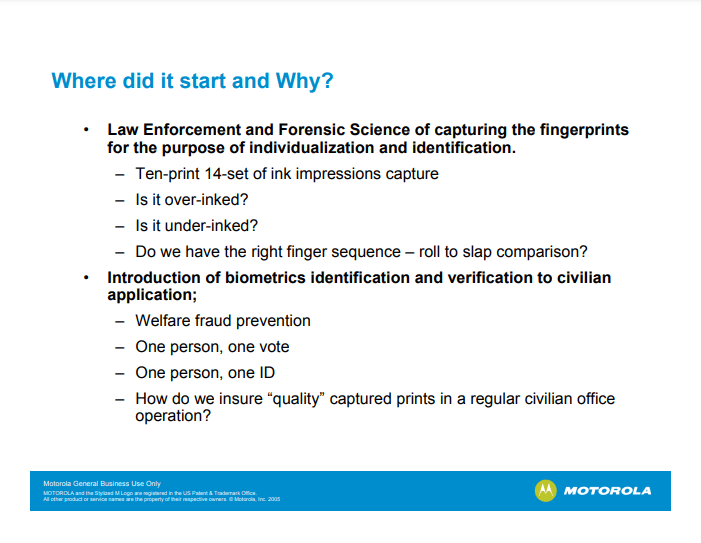
For a mention of companions to roll-to-slap comparison, as well as a number of other issues regarding fingerprint capture quality, see this 2006 presentation given by Behnam Bavarian, then a Vice President at Motorola.
In the 4-4-2 method, groups of prints are captured together, rather than individually. While it is possible to completely mess things up by capturing the left slaps when you are supposed to capture the right slaps, or by twisting your hands in a bizarre manner to capture the thumbs in reverse order, 4-4-2 gives you a reasonable assurance that the slap prints are captured in the correct order, ensuring a proper roll-to-slap comparison.
Well, unless the fingerprints are captured in an unattended fashion, or the police officer capturing the fingerprints is crooked.
But today’s ABIS systems are powerful enough to compare all ten submitted fingers against all ten fingers of every record in an ABIS database, so even if the submitted fingerprints falsely record finger 2 as finger 3, the ABIS will still find the matching print anyway.
Book ’em, Danno.


 Bredemarket
3 Comments