
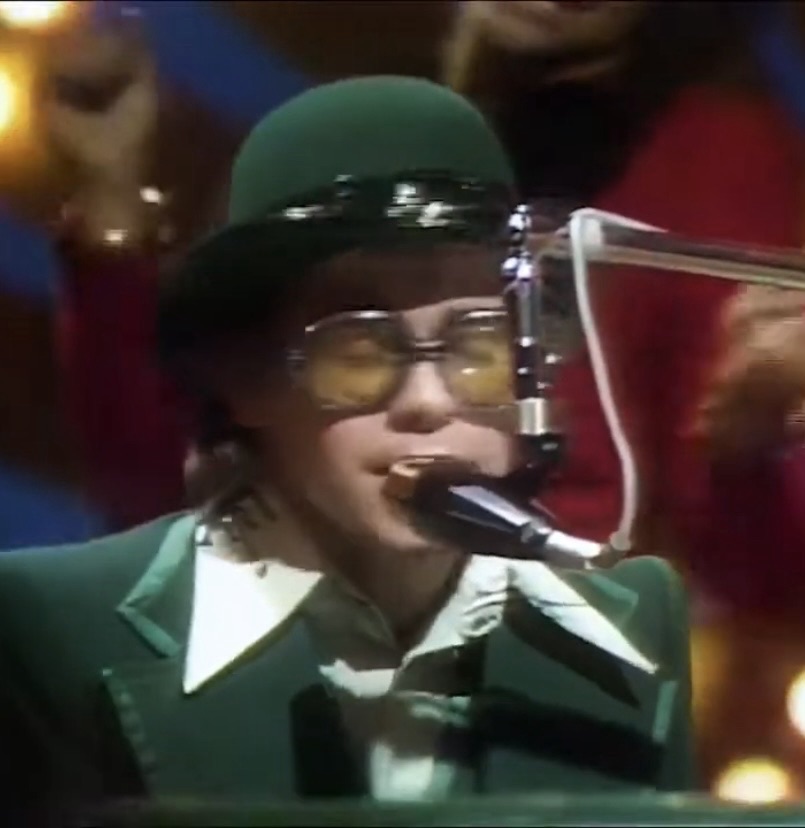
Some of you knew these deepfake thoughts were coming. Might as well finish side one.
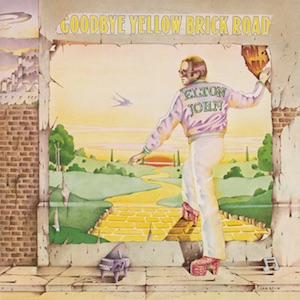
When we last met, I had discussed the other two tracks from side one of Elton John’s “Goodbye Yellow Brick Road.” Of course albums no longer have sides, but these three tracks/four songs give an idea of the breadth of Elton John’s first double album.
But this isn’t merely a music review. It also has to satisfy an Important Purpose. So this post about “Bennie and the Jets” will talk about…deepfakes.
Is it live?
After all the negativity that started the album, it was time for a little joy.
A happy song about a band.
About fans who read things in magazines.
All topped off by Elton’s charged performance in front of a live, cheering audience.
Um…no.
While Elton John has given many live performances, the recording of “Bennie and the Jets” is not one of them.
“Elton’s producer Gus Dudgeon wanted a live feel on this recording, so he mixed in crowd noise from a show Elton played in 1972 at Royal Festival Hall. He also included a series of whistles from a live concert in Vancouver B.C., and added hand claps and various shouts.”
But in retrospect, I can’t imagine the song as a straight studio recording. Dudgeon was right: it HAD to sound live.
And that “live” performance yielded a bigger surprise…and Reginald Dwight was most surprised of all.
Reginald Dwight, soul god
For those who don’t know who Reginald Dwight is, he was born in 1947 in an English town. A shy boy whose parents divorced in his teens, the most notable aspect of his life was his piano talent. He obviously wasn’t going to become a banker as his father originally intended.
Oh, and one more thing. Dwight was Caucasian. And all of his reinventions, including his adoption of the stage name Elton John, wasn’t going to alter that.
But Elton was pretty fly for a white guy. Worked his way up to musical ladder until he achieved success on his own. First with some notable performances, then some hit albums, then some number ones.
Reg could not have predicted what happened next. But first, let’s examine the relationship between “Bennie” and its album predecessor.
“When Elton recorded “Bennie And The Jets,” MCA, his label, wanted to make the song a single. Elton disagreed vociferously. His pick was “Candle In The Wind”…”
What persuaded Elton to change his mind…at least in the North American market?
“But Elton was swayed when “Bennie And The Jets” started doing well on Detroit R&B radio.”
Yes, R&B. “Bennie and the Jets” reached #15 on Billboard’s R&B charts. Which both pleased and amused Elton.
“What am I going to do on my next American tour? Play the Apollo for a week, open with ‘Bennie,’ and then say, ‘Thanks, you can all go home now.'”
If only there were a forum where he could play a single song for a large black audience…
Don Cornelius was all too happy to provide the forum.
Elton John wasn’t the first white artist to perform on Soul Train, but he was one of the few.
Technically this wasn’t a deepfake; Elton John didn’t pretend to be black. But he clearly absorbed some distinct musical influences: Little Richard, Ray Charles, Aretha Franklin, Fats Domino, Otis Redding, Nina Simone, Marvin Gaye, Wilson Pickett, James Brown, Stevie Wonder, The Temptations, Martha Reeves, Clyde McPhatter, and Sam Cooke. (Google Gemini helped me assemble this list.)
And he wasn’t a one hit wonder. Subsequent Philadelphia-influenced songs “Philadelphia Freedom” and “Mama Can’t Buy You Love” also made the R&B top 40.
Compare with Mick Jagger, who rarely made the R&B charts either as a Rolling Stone or as a solo artist. “Miss You” did, but Jagger’s highest placement was when he guested on the Jacksons’ “State of Shock.”

 Bredemarket
1 Comment