
I’ve been wanting to share my thoughts about this topic for a long time because it was important to me.
So now you’re probably asking, “John, if it’s important to you, why has it taken you so long to write the post?”
Read the post to find out!
Introduction
In past posts I’ve mentioned the Eisenhower Matrix, and I’ve also talked about how Bredemarket’s services fit into the Eisenhower Matrix.
Namely: if something is urgent, but not important enough for your own people to do, then perhaps Bredemarket can do it.
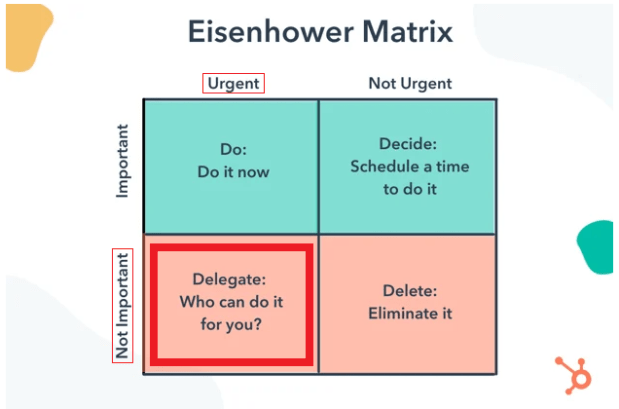
But in my previous discussions about the Eisenhower Matrix, I haven’t talked about the matrix gap. (Unrelated to the missile gap that Eisenhower’s successor claimed.)
- We’ll start this post by looking at who invented the Eisenhower Matrix (no, it wasn’t Eisenhower).
- Next, we’ll dive into the flaw in the Eisenhower Matrix (it’s too simple).
- After that, we’ll look at how to fix the flaw.
Eisenhower Didn’t Invent the Eisenhower Matrix
Eisenhower’s half contribution to the Eisenhower Matrix
First, I guess most of you already know that Dwight D. Eisenhower never viewed an Eisenhower Matrix before his death in 1969, since the matrix didn’t appear until 1989. Eisenhower may have been (literally) a Supreme Commander, but he could not time travel. (His great-granddaughter? Maybe.)

While the Eisenhower Matrix originates in something Eisenhower said, his statement ignores half of the matrix.
In a 1954 speech, Eisenhower quoted an unnamed university president when he said, “I have two kinds of problems, the urgent and the important. The urgent are not important, and the important are never urgent.”
From https://asana.com/resources/eisenhower-matrix
If you were to illustrate what Eisenhower actually said, there would only be two boxes—one for the urgent tasks, and one for the important tasks. There would be no need for a matrix per se, since Eisenhower claimed that the two categories never overlapped.
Stephen Covey thought differently.
Covey’s full contribution to the Eisenhower Matrix

In essence Covey asked, “What if Ike was wrong and there IS an overlap between the urgent and important?” Or, in his words:
In a knowledge-worker world where we are paid to think, create, and innovate, our primary tool for creating value is our brain. There are two basic parts of the brain: the Reactive Brain and the Thinking Brain….
We make choices based on two factors:
- Importance (how valuable is the result of doing it)
- Urgency (how soon does it need to be done)
The Reactive brain chooses urgency over importance because it wants to quiet the pressing, noisy issue. The Thinking brain chooses importance because it looks for high-payoff outcomes.
From https://www.franklincovey.com/the-5-choices/choice-1/
Covey then created the four-box matrix that indicates how items can have importance AND urgency, importance OR urgency, or neither. This created the Eisenhower Matrix we know and love, and which many of us find to be, um, “highly effective.”
The Eisenhower Matrix’s simplicity is its flaw
Part of the power of the Eisenhower Matrix is that it’s so simple to use. You just have to answer two questions to plug EVERY task into one of the four available boxes, and you’re then ready to do, decide, delegate, or delete as required.
But the simplicity of the matrix is misleading.
I’ll cite an example. How many times have you called a business and received an automated response saying, “Your call is important to us”?

Now I don’t go as far as Jessica Lim and claim that the “Your call is important to us” statement is an outright lie. Similar statements can be found far from the customer service world.

I am in the midst of a job hunt, and when I hold the first interview (usually with a Talent Acquisition Specialist), I make a point of asking when they expect to extend an offer and place someone in the position. Most of them respond, “As soon as possible,” and mean it. But they can’t provide an actual date.
Yes, it’s important for the customer service department to answer that phone, and it’s important for the talent acquisition department to fill that position.
But “importance” doesn’t mean that if all the customer service lines are busy that the VP of Customer Success will order new phone lines to be installed RIGHT NOW, and that everyone in the company will be mandated to answer phones RIGHT NOW until the backlog is cleared.
- Is there no budget for new phone lines? Rob a bank if you must. This is important.
- Is your Chief Financial Officer preparing for a quarterly earnings call tomorrow? Get to the phones. This is important.
And “importance” doesn’t mean that if a position needs to be hired, the Talent Acquisition Specialist is empowered to order every person in the interviewing and selection process to drop everything that they’re doing RIGHT NOW and devote 100% of their time to selecting a candidate.
- Are you on vacation or holiday? It doesn’t matter. Put down your drink! This is important.
- Are you in New Delhi? It doesn’t matter. Wake up! This is important.
In the Eisenhower Matrix, all “important” things are of equal importance, with no attempt to prioritize them.
Fixing the flaw
How do we solve the “everything is equally important” problem?
By defining four levels, including three levels of importance (TLOI).
- Important.
- Very important.
- Critically important.
- Not important.
(You can do the same with urgency and come up with gradations of urgency, but I’m not going to dive into that now. It’s…not important for what I want to say.)
Use of a more granular definition of importance provides benefits well beyond customer service and talent acquisition. Whenever you have to evaluate the importance of something, these more specific definitions will help.
Applying the correction to using Bredemarket
Let’s apply these gradations to my favorite topic—whether you should contract with Bredemarket to create your content marketing collateral. (OK, I doubt it’s your favorite topic, but trust me; there’s a “customer focus” issue here.)
For urgent content marketing needs, the existing Eisenhower Matrix provides only two choices:
- If the need is not important, delegate by contracting with Bredemarket.
- If the need is important, create the content yourself.

But when we apply the gradations, we have many more possible choices. In this case, we have four:
- If the need is not important, delegate it, but it doesn’t really matter to whom or what you delegate it. ChatGPT or Bard is “good enough,” even if the result is awful.
- If the need is important, delegate it to someone you trust to create very good content. Let them create the content, you approve it, and you’re done.
- If the need is very important, then you may delegate some of the work, but you don’t want to delegate all of it. You need to be involved in the content creation process from the initial meeting, through the review of every draft, and of course for the final approval. The goal is stellar content. We’ll come back to this later.
- If the need is critically important, then you probably don’t want to delegate the work and will want to do it yourself—unless you can find someone who is better than you in creating content.
So where does Bredemarket fit in to this list of expanded choices?
Depending upon your own talents, I fall in either the very important or the critically important category. I collaborate with you throughout the content creation process to ensure that you receive the best content possible.
If you agree that Bredemarket’s content creation services are very important (or critically important) to expanding your firm, let’s talk.
- Book a meeting with me at calendly.com/bredemarket. Be sure to fill out the information form so I can best help you.

- Email me at john.bredehoft@bredemarket.com.
- Contact me at bredemarket.com/contact/.
- Subscribe to my mailing list at http://eepurl.com/hdHIaT.

 Bredemarket
4 Comments