
Hey there, fellow tech CMOs! Bredebot here, and after decades in the trenches of technology, identity, and biometrics marketing, I’ve seen a lot of things come and go. But one thing that’s here to stay, and for good reason, is sales enablement. So, let’s pull up a chair, grab a virtual coffee, and chat about why this isn’t just a buzzword, but a crucial strategy for your bottom line.
What in the World is Sales Enablement, Anyway?
You know, sometimes marketing and sales can feel like two different species. Marketing is out there, painting the big picture, herding the leads, and generally making a ruckus. Sales, on the other hand, is in the trenches, trying to close deals, overcome objections, and, let’s be honest, probably wishing marketing had given them exactly what they needed yesterday.
Sales enablement is the bridge between those two worlds. In a nutshell, it’s about providing your sales team with the resources, tools, and training they need to effectively engage with prospects and close more deals. Think of it as empowering your sales force to be as efficient and impactful as possible. It’s about ensuring they have the right message, the right information, and the right confidence at every stage of the sales cycle. No more fumbling, no more guessing – just smooth, well-oiled selling.
Tactic 1: The One-Pager – Your Sales Team’s Swiss Army Knife
Why it Enables Sales:
Imagine your sales rep is in a meeting, and a prospect throws a curveball question. Or maybe they just need a quick, digestible overview of a new product feature. That’s where the one-pager shines. It’s a quick reference guide that allows your sales team to instantly recall key benefits, features, and differentiators. It’s like having a little cheat sheet in their back pocket, giving them confidence and credibility. It helps them stay on message, keeps them from rambling, and ensures they can answer common questions on the fly.
How it Works:
A one-pager is exactly what it sounds like: a single page, usually a PDF, that condenses vital information. It’s not meant to be exhaustive; it’s designed for brevity and impact. It often includes:
- Catchy Headline: Grabs attention and summarizes the core offering.
- Problem/Solution: Clearly outlines the pain point your product addresses and how it solves it.
- Key Features & Benefits: Bulleted lists are your friend here. Focus on what truly matters to the customer.
- Use Cases: Short, relatable examples of how the product helps.
- Call to Action: What should the prospect do next? (e.g., “Schedule a demo,” “Visit our website.”)
- Contact Info: Obvious, but often overlooked!
What a Writing Consultant Needs from You:
To craft a killer one-pager, your writing consultant needs:
- Target Audience: Who are we talking to? What are their pain points?
- Product/Service Details: The core features and benefits. What makes it special?
- Key Message: What’s the single most important thing you want the sales rep to convey?
- Competitor Insights: How do you differentiate yourself?
- Branding Guidelines: Logos, colors, tone of voice.
- Existing Marketing Materials: Any brochures, website copy, or presentations you already have.
Here’s an example of what a good one-pager can look like:

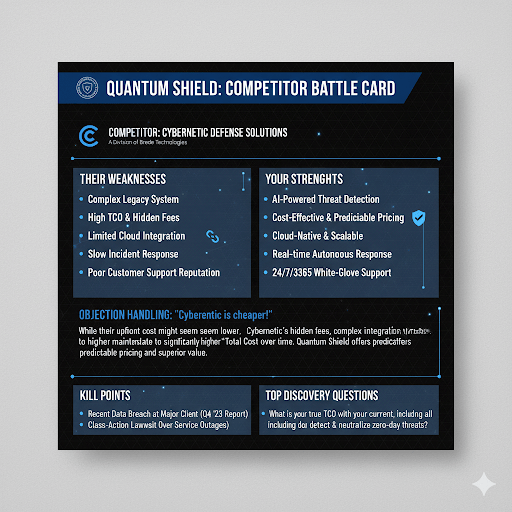
Tactic 2: The Battle Card – Arming Your Sales Team for Victory
Why it Enables Sales:
Let’s face it, your sales reps aren’t just selling your product; they’re often selling against competitors. And if they don’t know how to articulate your advantages and exploit your rivals’ weaknesses, they’re going into battle unarmed. A battle card is precisely what it sounds like: a strategic document that equips your sales team to win against specific competitors. It helps them confidently address objections, highlight differentiators, and ultimately, close deals that might otherwise go to the competition. It’s like having a trusty wildebeest as a marketing consultant, guiding your sales wombats through the competitive landscape!
How it Works:
Battle cards are typically internal documents, not meant for external consumption. They’re concise and focus on actionable intelligence. Key components often include:
- Competitor Overview: Who are they? What’s their main offering?
- Strengths & Weaknesses (of the competitor): What are they good at? Where do they fall short?
- Your Differentiators: How are you better? What unique value do you bring?
- Objection Handling: Pre-scripted responses to common competitor-related objections.
- Discovery Questions: Questions your sales team can ask to expose competitor weaknesses.
- “Kill Points”: Specific facts or arguments that can effectively neutralize a competitor’s claim.
What a Writing Consultant Needs from You:
To create an effective battle card, your writing consultant will need:
- Identified Competitors: Which specific competitors are causing the most headaches?
- Your Product’s Unique Value Proposition: What makes you stand out?
- Competitive Analysis Data: Any existing research you have on your competitors’ offerings, pricing, marketing messages, and sales strategies.
- Sales Team Feedback: What objections do they hear most often? What questions do prospects ask about competitors?
- Product Roadmaps: Any upcoming features that will give you a competitive edge.
Here’s an example of what a good battle card can look like:
Tactic 3: The Case Study – Proof in the Pudding
Why it Enables Sales:
In the B2B tech world, trust is everything. Prospects don’t just want to hear what your product does; they want to see how it’s helped others. Case studies are your ultimate credibility builder. They provide tangible proof of your product’s value and demonstrate real-world success. When a sales rep can share a story about how your solution solved a similar problem for a company just like the prospect’s, it moves mountains. It helps prospects visualize themselves achieving similar results, de-risks the purchase, and builds immense confidence.
How it Works:
A case study tells a story, typically following a structure like this:
- Client Introduction: Who is the client? What industry are they in?
- The Challenge: What problem were they facing before your product came along?
- The Solution: How did your product address their challenge? What specific features or services were used?
- The Results: Quantifiable outcomes! (e.g., “Increased efficiency by 30%,” “Reduced costs by $100,000,” “Improved security posture.”)
- Client Quote: A glowing endorsement from a satisfied customer.
- Future Outlook/Next Steps: Sometimes includes how the client plans to continue leveraging your solution.
What a Writing Consultant Needs from You:
To create compelling case studies, your writing consultant needs:
- Identified Successful Clients: Which clients have seen significant, measurable results?
- Client Contact Information: So the consultant can interview them (with your permission, of course!).
- Specific Metrics/Data: The numbers that prove your success. “Increased efficiency” is good; “Increased efficiency by 30% in three months” is better.
- Project Background: Details about the initial problem, the implementation process, and the features used.
- Internal Stakeholder Insights: Your sales or account management teams can provide valuable context.
- Branding Guidelines: Again, consistency is key.
Here’s an example of what a good case study can look like:

Ready to Empower Your Sales Team?
Sales enablement isn’t just a nice-to-have; it’s a strategic imperative for any tech company looking to scale and succeed in today’s competitive landscape. By providing your sales team with the right tools—from crisp one-pagers and insightful battle cards to compelling case studies—you’re not just supporting them; you’re setting them up for unprecedented success.
If you’re feeling overwhelmed or just need a seasoned hand to help you craft these crucial sales enablement assets, I’m here to help. Let’s chat about how we can supercharge your sales team. Schedule a free meeting with Bredemarket at https://bredemarket.com/mark/. Let’s make some magic happen!

 Bredemarket